
How Much Protein Do I Need: how much protein do i need for daily intake
So, you’re wondering, "How much protein do I actually need?" You've probably heard the standard advice: most healthy adults need a baseline of 0.8 grams of protein per kilogram of body weight. That’s the official Recommended Dietary Allowance (RDA), but here's what most people miss—it's the bare minimum to prevent deficiency, not the optimal amount to help you thrive.
Think of it as the amount of fuel needed to keep the car idling, not to win a race. Your personal protein needs are a moving target, and that baseline number can shift dramatically based on your activity, age, and goals.
Your Personal Protein Blueprint
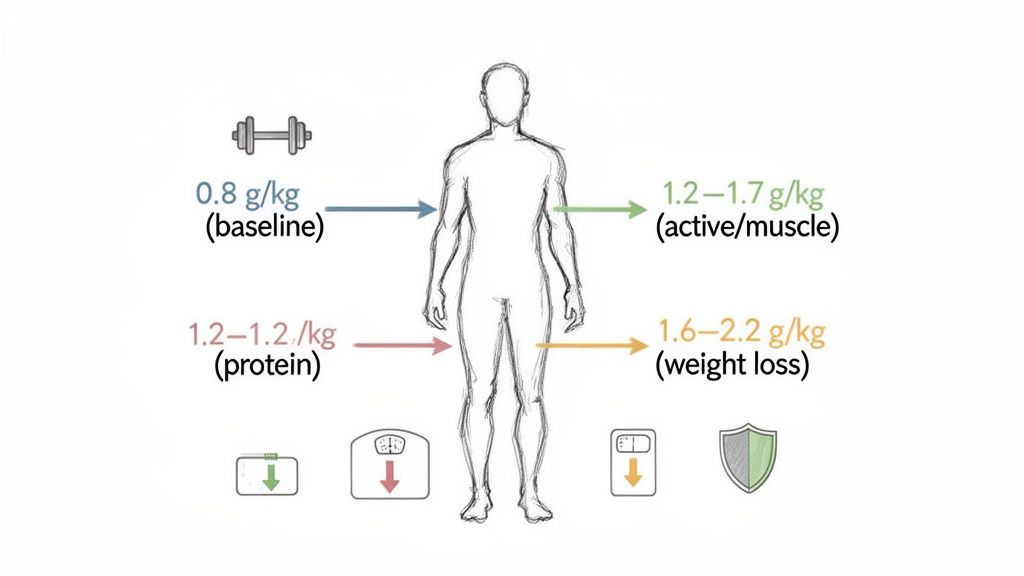
The real answer isn't a single static number. It's about figuring out what your body needs right now to perform at its best.
I like to use a construction analogy: you need a lot more bricks to build a new house from the ground up than you do to just patch a few cracks in a wall. If you're building muscle, recovering from tough workouts, or trying to lose fat while preserving lean mass, your body's demand for protein—the "bricks"—is significantly higher.
Why One Size Never Fits All
A single recommendation just doesn't work because our bodies are constantly adapting. The question isn't just "how much protein?" but "how much protein for me, for my goals?" Several key factors will influence your number.
- Activity Level: It’s simple, really. The more you move, the more you need. If you're mostly sedentary, your needs are lower. But if you're hitting the gym, running, or even just have a physically demanding job, your muscles are constantly being broken down and need more protein to repair and come back stronger.
- Health Goals: What are you trying to achieve? Someone aiming to build muscle needs a surplus of protein to support new growth. If weight management is the goal, higher protein intake is a game-changer because it’s incredibly satiating, helping you feel full and satisfied, which naturally helps manage your calorie intake.
- Age: As we get older, our bodies experience something called anabolic resistance, which means we become less efficient at using the protein we eat to build and maintain muscle. To counteract this and preserve strength and mobility, older adults often need to consume more protein than their younger counterparts.
The World Health Organization suggests 10-15% of daily calories should come from protein, which works out to about 50-75 grams for a 2,000-calorie diet. But this is a very general guideline. Interestingly, recent research on global protein intake trends shows the average supply has climbed to over 90 grams per person daily—a number that still masks the huge variation between individuals.
Quick Protein Needs Reference Guide
To help you get a better handle on your own starting point, I've put together this quick reference table. It breaks down common protein targets based on specific goals, giving you a much more personalized estimate than the basic RDA.
Use this table to find the range that best fits your current lifestyle and ambitions. It's a fantastic starting point.
From here, we'll dive into how to calculate your specific number and, more importantly, how to hit that target without feeling overwhelmed. The goal is to build an intuitive feel for what your body needs, turning this knowledge into an easy, sustainable part of your daily life.
Why Protein Is Your Body’s Most Important Building Block
When you hear the word "protein," your mind probably jumps straight to muscles, right? That’s what we all think of first. And while protein is absolutely essential for building and maintaining muscle, focusing only on that is like saying a car’s engine is only for making noise. The truth is, protein is the master component that keeps your entire body running smoothly.
Think of it this way: protein is broken down into amino acids, which are the fundamental raw materials for nearly every process in your body. They build your muscles and tissues, sure, but they also create the enzymes that power chemical reactions and the hormones that send signals from your brain to your toes. Without enough of this crucial material, the whole system starts to slow down. That’s why figuring out your protein needs is about so much more than fitness—it's about how you feel and function every single day.
The Unseen Jobs of Protein
Beyond the gym, protein is working behind the scenes in ways you might not expect. These amino acids are constantly being used for critical tasks that keep you healthy and resilient.
- Enzyme Production: Every time you digest food, enzymes made from protein are doing the heavy lifting. They break down what you eat so your body can actually absorb the nutrients. If you're low on protein, your digestive system just can't work at its best.
- Hormone Regulation: Many of the hormones that control your appetite, mood, and even your stress response are built from protein. If you've ever dealt with persistent cravings or unexplained mood swings, a lack of protein could easily be part of the picture.
- Immune Defense: Your immune system's front-line soldiers are antibodies, which identify and fight off bacteria and viruses. These antibodies are made of protein, so a low intake can leave your defenses down and make you more likely to get sick.
Simply put, a protein-rich diet is your foundation for better energy, sharper focus, and a stronger immune system. For a deeper look at the science behind protein and its role as a core building block, we have some great educational resources you can explore.
Your body is in a constant state of repair, breaking down old, worn-out cells and building new ones. Protein provides the essential materials for this ongoing maintenance project. It’s literally why your hair grows, your skin heals, and you recover from one day to the next.
How Protein Impacts Your Daily Energy and Satiety
One of the first things people notice when they increase their protein intake is how it changes their hunger and energy. Ever have a carb-heavy breakfast like a pastry or sugary cereal, only to feel tired and hungry an hour later? That’s the classic blood sugar spike and crash.
Protein changes the game entirely. Because it digests much more slowly than carbohydrates, it helps stabilize your blood sugar. This gives you a steady, reliable stream of energy instead of that frustrating rollercoaster. This is precisely why a breakfast with a good dose of protein can keep you feeling full and focused straight through to lunch.
This powerful effect on satiety—the feeling of fullness—is a secret weapon for sustainable health. When your meals actually satisfy you, you're far less likely to find yourself reaching for sugary snacks or overeating later on. It’s a simple shift that puts you back in control of your appetite without feeling like you're depriving yourself.
Calculating Your Personalized Protein Target
Alright, let's get down to the brass tacks: finding your number. Instead of settling for a one-size-fits-all figure, we're going to calculate a protein target that’s actually built for your body, your activity level, and your goals. It's a lot simpler than it sounds, and it gives you a solid benchmark to work with.
The goal is to move beyond the basic 0.8 grams per kilogram (g/kg) recommendation—which is really just a baseline to prevent deficiency—and find a multiplier that reflects your life.
This quick flowchart is a great way to start visualizing where you might land on the protein spectrum.
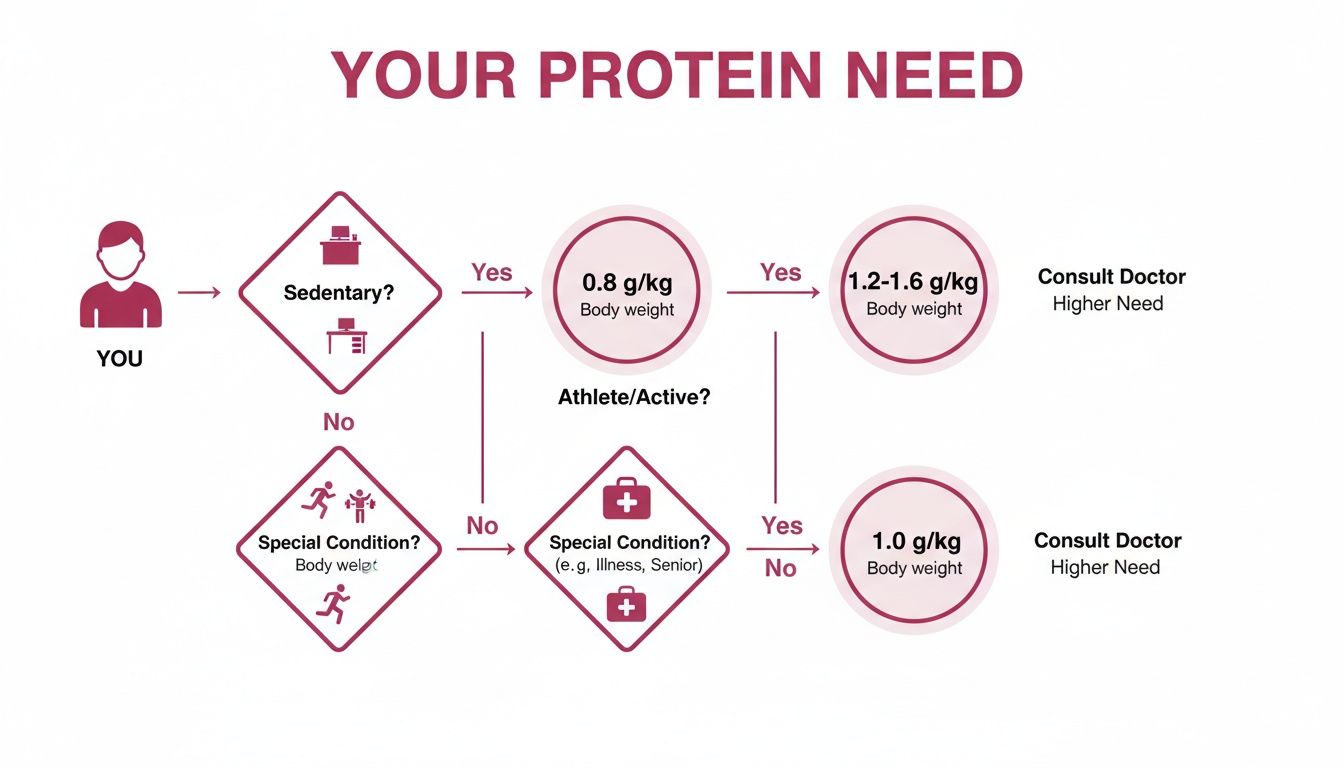
As you can see, the moment you go from a sedentary lifestyle to an active one, your needs jump up. If you're looking to build muscle or manage your weight, they climb even higher.
Finding Your Protein Range for Specific Goals
First things first, you'll need your weight in kilograms. If you're used to pounds, no problem—just divide your weight by 2.2.
Quick Conversion Examples:
- A 150-pound person is about 68 kg (150 ÷ 2.2).
- A 200-pound person is about 91 kg (200 ÷ 2.2).
Got your number? Great. Now you can use one of the multipliers below to find your daily protein range.
Think of these multipliers like gears on a bike. You wouldn't use the same low gear to climb a steep hill that you use for cruising on a flat road. Your protein intake should shift the same way, depending on the demands you're placing on your body.
Here are the most common scenarios.
1. General Health (Mostly Sedentary)
This is your baseline if you aren't exercising regularly and are simply aiming to maintain good health.
- Multiplier: 0.8 to 1.2 g/kg
- For a 68 kg person: That's around 68 grams per day (68 kg x 1.0 g/kg).
2. Active Lifestyle & Muscle Building
If you’re hitting the gym, running, or playing sports regularly (think 3-5+ times a week) or are intentionally trying to gain muscle, this is your range.
- Multiplier: 1.2 to 1.7 g/kg
- For a 68 kg person: You’d be looking at roughly 109 grams per day (68 kg x 1.6 g/kg).
3. Supporting a Weight Loss Goal
When you're in a calorie deficit, a higher protein intake is your best friend. It helps you hang onto precious muscle mass and is fantastic for keeping you feeling full, which makes it easier to stick to your plan.
- Multiplier: 1.6 to 2.2 g/kg
- For a 91 kg person: This could mean aiming for 164 grams per day (91 kg x 1.8 g/kg).
4. Healthy Aging (For Adults Over 65)
As we get older, our bodies need more protein to fight off age-related muscle loss, a condition known as sarcopenia. Upping your intake helps maintain strength, mobility, and independence.
- Multiplier: 1.2 to 1.7 g/kg
- For a 68 kg person: A good target would be around 88 grams per day (68 kg x 1.3 g/kg).
These numbers aren't just pulled out of thin air. While the average adult in the UK eats about 76 grams a day, the evidence strongly supports higher intakes for specific goals. For instance, protein recommendations from nutrition experts show that guidelines for Olympic athletes often fall between 1.2-1.8 g/kg, and some sports scientists even push that to 3.0 g/kg for bodybuilders in a cutting phase. More importantly, recent research is strongly advocating for adults over 65 to consume at least 1.2 g/kg to preserve muscle—a significant jump from the old baseline.
Remember, your calculated target is a guide, not a gospel. Use it as a starting point to build awareness around your choices. It's an evidence-based tool to help you eat in a way that truly supports where you want to go.
How to Visualize Protein Portions Without Counting
Knowing your daily protein target is one thing, but actually hitting it is another. Let's be realistic—most of us aren't going to carry a food scale around or meticulously weigh every single meal. The secret to consistently getting enough protein lies in developing an intuitive feel for portion sizes, turning the math into a simple visual skill.
The goal isn't to be perfect down to the last gram. It's about building a "protein radar" that helps you make smart choices on the fly, whether you're at a restaurant, a friend's barbecue, or just staring into your own fridge. This is how tracking becomes a sustainable habit instead of a stressful chore.
The Hand-Portion Method: A Simple Guide
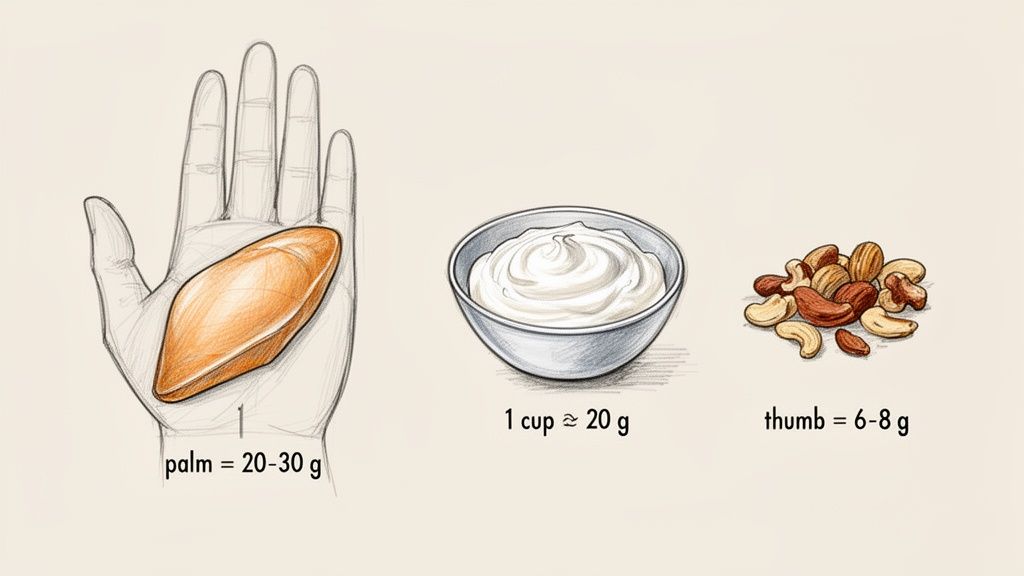
You already have the most convenient measuring tool with you at all times: your hand. Because it’s proportional to your own body size, it’s a surprisingly effective and personalized guide for estimating food portions.
Here’s how you can start using it today:
- Palm-Sized Portion (for meat, poultry, fish): The surface area and thickness of your palm (not including your fingers) is a fantastic visual for a single serving of protein. For a chicken breast, a piece of salmon, or a small steak, this usually equals about 20-30 grams of protein.
- Cupped Hand (for nuts, seeds, beans): A handful of almonds or a scoop of chickpeas to top a salad is roughly what you can fit in your cupped hand.
- Two Thumbs (for nut butters): For denser foods like peanut or almond butter, the size of your two thumbs put together is a good benchmark for one serving.
This method isn’t an exact science, but it’s a brilliant mental shortcut. Using your hand as a consistent reference point helps you quickly eyeball a plate and know if you’re in the right ballpark or need to add a little more protein.
By visualizing portions instead of weighing them, you’re building a more flexible and less rigid relationship with food. It’s a skill that empowers you to make mindful decisions in any environment, fostering a sense of control without the burden of counting.
What 25 Grams of Protein Actually Looks Like
"Palm-sized" is a great start, but it helps to have a mental photo album of what a solid 20-25 gram serving of protein looks like in different foods. This is a common and effective target for a main meal or a hearty snack.
To help you build that internal radar, here’s a quick comparison.
You can see right away how much the volume changes. Getting 25 grams of protein from lentils requires a much larger portion than getting the same amount from chicken. This is why just "eating more" doesn't always work; protein density matters. A huge salad might have very little protein, while a small cup of Greek yogurt packs a powerful punch.
Once you start getting familiar with these visual equivalents, you’ll automatically see your plate differently. You'll recognize the building blocks in your food, making it far easier to know if you're getting what you need.
Alright, you've figured out your personal protein target. That's the first big step. Now for the fun part: deciding where that protein will come from.
When you walk through the grocery store, the options can feel a little overwhelming. You've got the classic chicken and fish, but then there's tofu, lentils, Greek yogurt, and a dozen different protein powders. It's easy to get bogged down in the debates—animal vs. plant, complete vs. incomplete. But let's cut through the noise. The real goal is to find high-quality protein sources you actually enjoy eating, because consistency is what ultimately gets results.
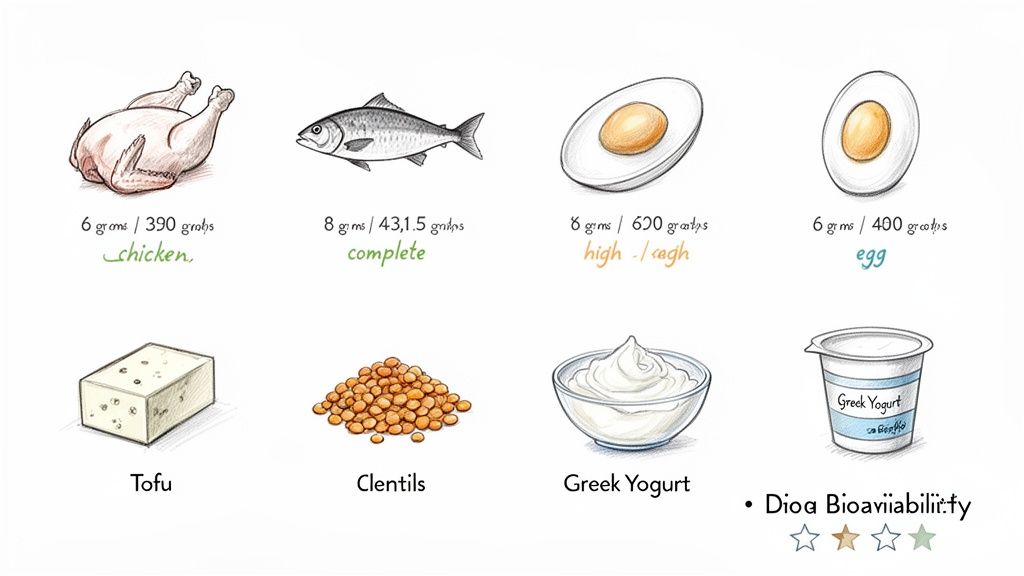
Let's look at what really matters when choosing your protein.
H3: Complete Proteins vs. A Complete Diet
You've probably heard the term complete protein. It sounds important, and it is, but it's also widely misunderstood. A food is considered "complete" if it contains all nine of the essential amino acids—the building blocks of protein that our bodies can't make themselves.
Animal sources like meat, fish, eggs, and dairy are all naturally complete proteins. This is part of what makes them so efficient.
Think of essential amino acids as a set of nine unique keys needed to unlock different muscle-building and repair processes in your body. A "complete" protein source gives you the whole keychain at once.
So, what about plants? Many plant foods like beans, grains, and nuts are "incomplete," meaning they might be low in one or two of those essential amino acids. For years, this led to the myth that you had to painstakingly combine specific plant foods (like rice and beans) in the same meal to form a complete protein.
We now know that's not necessary. Your body is smart; it maintains a pool of amino acids. As long as you eat a variety of plant-based protein sources throughout the day—say, oatmeal and nuts for breakfast and lentil soup for dinner—your body will collect all nine "keys" it needs over a 24-hour period. It’s about a complete diet, not just a single complete protein source.
H3: Animal vs. Plant-Based Protein Sources
So, which is better? The honest answer is: it depends entirely on you. Both animal and plant-based proteins offer incredible benefits, and for many people, a mix of the two works best. There’s no single "best" source, only what’s best for your body, budget, and lifestyle.
Here’s a quick comparison of some of the most popular protein sources out there to help you see how they stack up.
Animal vs. Plant-Based Protein Sources
Choosing a mix of these foods is a fantastic way to ensure you’re getting a broad spectrum of nutrients alongside your protein.
H3: Building a Smart and Sustainable Protein Plan
The best protein strategy is one you can stick with long-term. There's no need to be rigid or pick a side in the animal-versus-plant debate. Many people find success by simply being more intentional.
Maybe you start with "Meatless Mondays" or try swapping half the ground meat in a recipe with lentils or mushrooms. These small changes add up, boosting your fiber intake and diversifying your diet without feeling like a major overhaul. Once you know what to aim for, hitting your goals becomes much easier when you have a few go-to meals in your back pocket. Finding some easy high protein dinner recipes can make weeknight cooking feel effortless.
Ultimately, remember that quality and variety are just as important as quantity. Focus on whole, minimally processed foods, listen to your body, and choose the proteins that make you feel your best.
Building Sustainable Protein Habits with Mindful Eating
Knowing your daily protein target is one thing, but actually hitting that number consistently is a whole different ballgame. The real change happens when you can stop thinking about it so hard—when getting enough protein becomes an effortless, automatic part of your routine.
So many people fall into the same trap: they try to cram most of their protein into a single huge meal, usually dinner. But our bodies don't work that way. There's a limit to how much protein can be used for muscle repair and growth at any one time. A better approach is to spread your intake evenly across the day.
Think of it like keeping a fire going. Instead of throwing one giant log on at night, you add smaller logs every few hours to maintain a steady, consistent flame. This gives your body a constant supply of amino acids, which helps stabilize your energy, keep you feeling full, and maximize your ability to build and repair tissue.
Make Your Meals Work for You
You don't need a total diet overhaul. The secret is to make small, smart tweaks to the meals you’re already eating. A little more intention can go a long way in boosting your protein without making you feel like you're on a restrictive plan.
- Front-Load Your Day: Starting your morning with a protein-packed breakfast is probably the single most powerful change you can make. Swapping a bagel for scrambled eggs, Greek yogurt, or a tofu scramble sets your metabolism for the day, keeps you focused, and nips those mid-morning cravings in the bud.
- Prep Smart Snacks: When that 3 p.m. hunger hits, having a protein-rich snack on hand is a game-changer. A couple of hard-boiled eggs, a container of cottage cheese, some edamame, or a small handful of almonds will tide you over far better than sugary or carb-heavy options.
- Reimagine Your Plate: At lunch and dinner, start by building your meal around your protein. Make it the star of the show. Fill about a quarter of your plate with a solid source like chicken, fish, or lentils first, then fill in the rest with veggies and healthy carbs.
These small shifts are about working smarter, not harder. They ensure you're getting quality protein at every meal, making it much easier to hit your daily goal without even trying.
The goal is to make healthy eating feel less like a chore and more like a supportive habit that runs on autopilot. It's about building a system for yourself so you aren't constantly relying on willpower to make good choices.
Turning Actions into Lasting Habits
So, how do you make these new actions stick for good? This is where a little mindfulness—supported by simple tools like those in the Superbloom app—can make all the difference. Forget obsessively counting every gram. The real power is in awareness.
Something as simple as a daily check-in or snapping a photo of your meals helps you see your own patterns without judgment. You might realize you’re always skipping protein at breakfast or that your afternoon energy crash lines up perfectly with a carb-heavy lunch. That awareness is the first step.
From there, you can make small, intentional changes. Maybe it’s tossing a scoop of protein powder into your morning smoothie or making sure your salad has a palm-sized portion of grilled salmon. Over time, these mindful adjustments become second nature. Hitting your protein goals becomes less of a task and more of an enjoyable, automatic part of living well.
Answering Your Top Protein Questions
Once you start paying attention to protein, a lot of questions naturally come up. It's totally normal to wonder about the details as you fine-tune your approach. Let's clear the air on a few of the most common myths and concerns so you can move forward with confidence.
Can You Eat Too Much Protein?
This is a big one. You’ve probably heard the warning that high-protein diets are hard on your kidneys. The concern stems from the fact that when your body breaks down protein, it creates natural byproducts that your kidneys are in charge of filtering.
But here’s the good news: healthy kidneys are incredibly efficient and can easily handle the demands of a higher protein intake. That’s true even for active people eating up to 2.2g/kg of body weight. The risk is really only a factor for individuals with a pre-existing kidney condition, who should always follow their doctor's guidance. The goal isn’t to eat protein excessively, but to hit your own personal sweet spot.
Does Protein Timing Really Matter?
The single most important thing is hitting your total daily protein target. But once you have that down, a little strategy around timing can give you an extra edge. Spreading your protein intake throughout the day helps your body use it far more effectively.
Think of it as providing a steady stream of building blocks rather than dumping a whole truckload of bricks on a construction site all at once. A consistent supply supports better muscle repair, stabilizes energy levels, and keeps you feeling full.
A simple and effective goal is to aim for 20-40 grams of protein at each meal. That post-workout shake or meal is definitely helpful for recovery, but don't forget that a steady supply all day long often makes the biggest difference for your overall goals.
Will Eating More Protein Make Me Bulky?
I hear this myth all the time, especially from women. The simple answer is no: eating enough protein will not automatically make you “bulky.” Building significant muscle mass is a very specific process that requires two key ingredients working together: a consistent calorie surplus (eating more calories than you burn) and a very dedicated, heavy resistance training program.
For most of us, getting the right amount of protein actually does the opposite. It helps you build and maintain lean muscle while your body loses fat, which is the foundation of a strong, toned physique. Plus, since protein is so good at keeping you full, it’s one of the best tools you have for managing your weight.
Ready to stop guessing and start understanding your body's unique patterns? Superbloom uses simple check-ins and AI-powered insights to help you build healthier habits without the stress of calorie counting. Discover what your body is telling you and make lasting changes by visiting https://superbloomapp.com.