
How to Improve Impulse Control for Mindful Eating
Ever find yourself tearing open a bag of chips after a brutal meeting, even though you just had lunch? You’re definitely not alone. The constant struggle with impulse control isn't some personal failing or a lack of willpower. It's a biological tug-of-war playing out inside your brain, every single day.
Why Controlling Impulses Feels Like an Uphill Battle
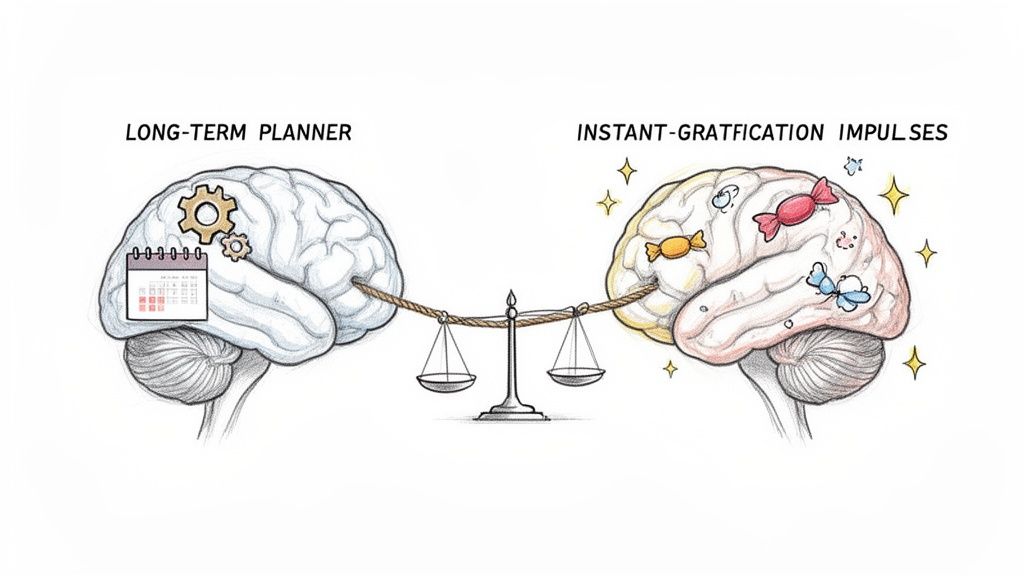
That internal debate you have—"Just one cookie" versus "I'm trying to eat healthier"—is very real. It’s a constant negotiation between two very different parts of your brain: the thoughtful, long-term planner and the lightning-fast, pleasure-seeking reactor. Getting a handle on this dynamic is the first, most crucial step toward taking back control.
The Brain's Internal Tug-of-War
Imagine your brain has two managers with completely different priorities.
On one side, you have the prefrontal cortex (PFC). Think of it as your brain's CEO, sitting right behind your forehead. It’s the part of you that’s focused on the big picture.
- It handles long-term planning, connecting today's actions to your future goals.
- It's the home of rational decision-making, weighing the pros and cons before you act.
- It's also in charge of emotional regulation, helping you manage stress without immediately reaching for a quick fix.
Then there's the other manager: the limbic system. This is a much older, more primitive part of the brain that’s hardwired for survival and immediate rewards. It's the source of your cravings, your gut reactions, and your deepest habits. When stress, boredom, or sadness hits, your limbic system doesn't think—it just screams for something to make you feel better right now.
This isn't a battle of "good" versus "bad." It's pure physiology. Your limbic system reacts in milliseconds, while your prefrontal cortex needs a lot more time and energy to catch up and hit the brakes.
This is exactly why impulsive choices so often happen when you’re tired or overwhelmed. A long, draining day saps the mental energy your PFC needs to stay in command, basically handing the controls over to your reactive limbic system.
Moving Beyond Willpower and Self-Blame
When we frame this struggle as a simple matter of willpower, we get stuck in a nasty cycle of shame and frustration. It’s not that you're weak; it's that your brain evolved for immediate gratification—a trait that was incredibly useful for our ancestors' survival.
The great news? Your brain is trainable. A huge part of the puzzle is mastering skills like What is Emotional Regulation and How to Master It. By building simple, practical skills and a little self-awareness, you can strengthen your PFC and give it a fighting chance.
In the rest of this guide, we'll walk through exactly how to do that. We'll focus on actionable strategies, not rigid rules, to help you build the skills for lasting change.
Become a Detective of Your Own Behavior

Before you can change an impulsive habit, you have to get to know it first. The real starting point for building better impulse control is simply noticing what’s pulling your strings. You've got to put on your detective hat and observe your own behavior, not with judgment, but with genuine curiosity.
This isn’t about beating yourself up; it's about getting curious. Impulsive actions rarely happen out of the blue. They're almost always a reaction to something specific—a feeling, a situation, a certain time of day, or even a particular person. When you can pinpoint these triggers, you start to see the "why" behind your actions, moving from blindly reacting to consciously understanding.
Start Tracking Your Triggers
The most powerful way to see these patterns is to start logging them. This doesn’t need to be a huge, complicated project. You could use a simple notebook, or even better, an app like Superbloom that’s built for this exact kind of self-discovery.
The next time an impulse hits, just pause for a second. Before you act, try to note a few key details. Don’t just write down "wanted chips." Zoom out and capture the whole scene.
- What time is it? Is that 3 PM energy slump a reliable trigger for a sugar hunt?
- Where are you? In the office kitchen? On the couch? Mindlessly scrolling on your phone in bed?
- Who are you with? Sometimes certain social settings can be a quiet permission slip for mindless eating.
- What just happened? Did you just fire off a stressful work email? Were you feeling bored and restless?
- How are you feeling, really? Try to name the specific emotion. Anxious? Lonely? Frustrated? Exhausted?
This simple act of tracking builds a powerful muscle of self-awareness. Over time, the data you gather in your Superbloom check-ins will start to tell a story. You might suddenly realize that what felt like a random craving for ice cream is actually your go-to response for feeling overwhelmed by your inbox.
Your goal isn't to stop the impulse right away. It's to gather intelligence. Think of each log as a clue that helps you build a map of your internal world, showing you exactly where you need to pave a new road.
The Power of Noticing
What’s fascinating is that this kind of mindful observation is, in itself, a form of self-control training. Behavioral psychology research shows that even small, consistent self-control exercises can create lasting improvements that spill over into other parts of your life, like resisting that tempting snack when you're not hungry.
This idea has deep roots, going all the way back to Walter Mischel's famous marshmallow experiments in the 1960s. He found that kids who could delay gratification ended up with better life outcomes years later, from higher SAT scores to lower BMIs as adults. You can learn more about the fascinating history of impulsivity research to see how far we've come.
By simply and consistently logging your triggers, you’re doing more than just collecting data. You're actively strengthening the part of your brain that makes conscious choices. This first step is the bedrock for all the meaningful change that comes next.
Design Your Environment for Effortless Success
Think of willpower as a battery. It starts the day fully charged, but every decision you make, every temptation you resist, drains a little bit of that power. Relying on sheer grit to get through the day is a surefire way to end up running on empty, which is exactly when impulses take over.
A much smarter, more sustainable approach is to design your environment so it does the heavy lifting for you. This is all about making the right choices the easy choices.
Making Healthy Choices the Obvious Choices
The old saying "out of sight, out of mind" is a cliché for a good reason—it’s true. The things we see and can access easily are the things we're most likely to reach for. You can use this simple psychological quirk to your advantage.
- Go Front and Center: Place a bowl of fresh fruit on your kitchen counter. Keep pre-cut veggies and hummus at eye level in the fridge. When a healthy option is the first thing you see, you're far more likely to grab it.
- Create a Little Friction: On the flip side, make the less-healthy stuff harder to get to. Move that bag of chips to a high shelf or the back of the pantry. That little bit of extra effort required can be enough to make you pause and reconsider.
- The Power of Pre-Portioning: It’s so easy to mindlessly eat your way through a family-sized bag of pretzels. Take five minutes after grocery shopping to divide snacks into smaller, single-serving bags. This creates a natural "stop" sign for your brain.
This is a concept known as choice architecture, and it’s about intentionally setting up your surroundings to nudge you toward your goals. You're not just fighting urges; you're engineering a space where you don't have to fight them nearly as often.
Here’s a quick look at how you can swap common impulsive reactions with more intentional ones.
Impulsive Choice vs Intentional Swap
This isn't about perfection; it’s about making the better choice just a little bit easier.
Taming Your Digital Triggers
Your physical space is only half the battle. Our digital world is practically designed to trigger our impulses. Think about it: food delivery apps with push notifications, perfectly staged food photos on Instagram, and ads that seem to read your mind. They’re all built to make you crave and act without thinking.
By curating your environment, you're not just avoiding temptation—you're building a system where the easiest choice is also the healthiest one. This creates a powerful feedback loop that reinforces positive habits without constant effort.
You can take back control here, too. A few quick tweaks can make a massive difference.
Unsubscribe from those tempting promotional emails from fast-food chains. Turn off push notifications for food delivery apps—you can still order when you decide you want to, but you won't be prompted by a random alert when you’re not even hungry. This thoughtful curation of both your physical and digital spaces is a cornerstone of building impulse control that actually lasts.
Strengthen Your Brain with Physical Activity
When we think about exercise, we usually picture toned muscles or a healthy heart. But one of its most powerful benefits is actually inside your skull. Physical activity is a direct upgrade for your prefrontal cortex—the part of your brain that acts as your CEO, handling rational decisions and putting the brakes on knee-jerk urges.
Moving your body gets more blood flowing to your brain, which is crucial for building new neural pathways. Think of it as literally strengthening the circuits that help you say "no" to that second slice of cake or "yes" to tackling a tough project instead of scrolling social media. You're fortifying the very part of your brain that overrides the limbic system's demands for instant gratification.
You Don't Need an Intense Workout
One of the biggest misconceptions I see is the belief that you have to be dripping in sweat for exercise to "count" for your brain. That’s just not true. While a hard workout is great, what really moves the needle for impulse control is consistency, not intensity. A simple, brisk walk is often all it takes.
Let’s get specific. Picture this: you've had a rough day, and a box of donuts is calling your name. That's your impulse talking. A fascinating 2018 study found that regular, moderate exercise gives you a much better shot at winning that internal debate.
Participants simply walked or jogged at a comfortable pace. The results? 13 out of 16 of them held onto their improved self-control a full month after the program ended. This isn't just a temporary boost; it’s evidence that exercise can genuinely reshape your brain for better long-term decision-making. You can dig into the details of the study on how exercise boosts self-control on Futurity.org.
This shifts the entire perspective on exercise. It's not just a chore for weight management; it's a proactive tool for building mental fortitude.
Making Movement a Non-Negotiable Habit
Okay, so we know it works. But how do you actually fit it into a life that's already overflowing? The secret is to stop thinking of exercise as an event and start weaving it into the fabric of your day.
Here are a few practical ways to do just that:
- The Post-Dinner Stroll: A 20-minute walk after your last meal does wonders. It helps with digestion and, more importantly, it calms your nervous system, making you far less likely to stress-eat late at night.
- The "Exercise Snack": I love this one. Find tiny pockets in your day for quick bursts of movement. Do a few sets of squats while waiting for your coffee to brew or some push-ups during a TV commercial. It resets your mind and gets the blood pumping.
- Active Commuting: If it's an option, try walking, biking, or just hopping off the bus or train one stop early. It builds activity right into your schedule without you having to find extra time for it.
These small, consistent habits create a powerful feedback loop. You're building a supportive routine that strengthens your brain’s ability to make the choices you actually want to make.
This ties in perfectly with the idea of designing your environment for success. A stronger prefrontal cortex from exercise, combined with a space that makes good choices easy, is an unstoppable combination.
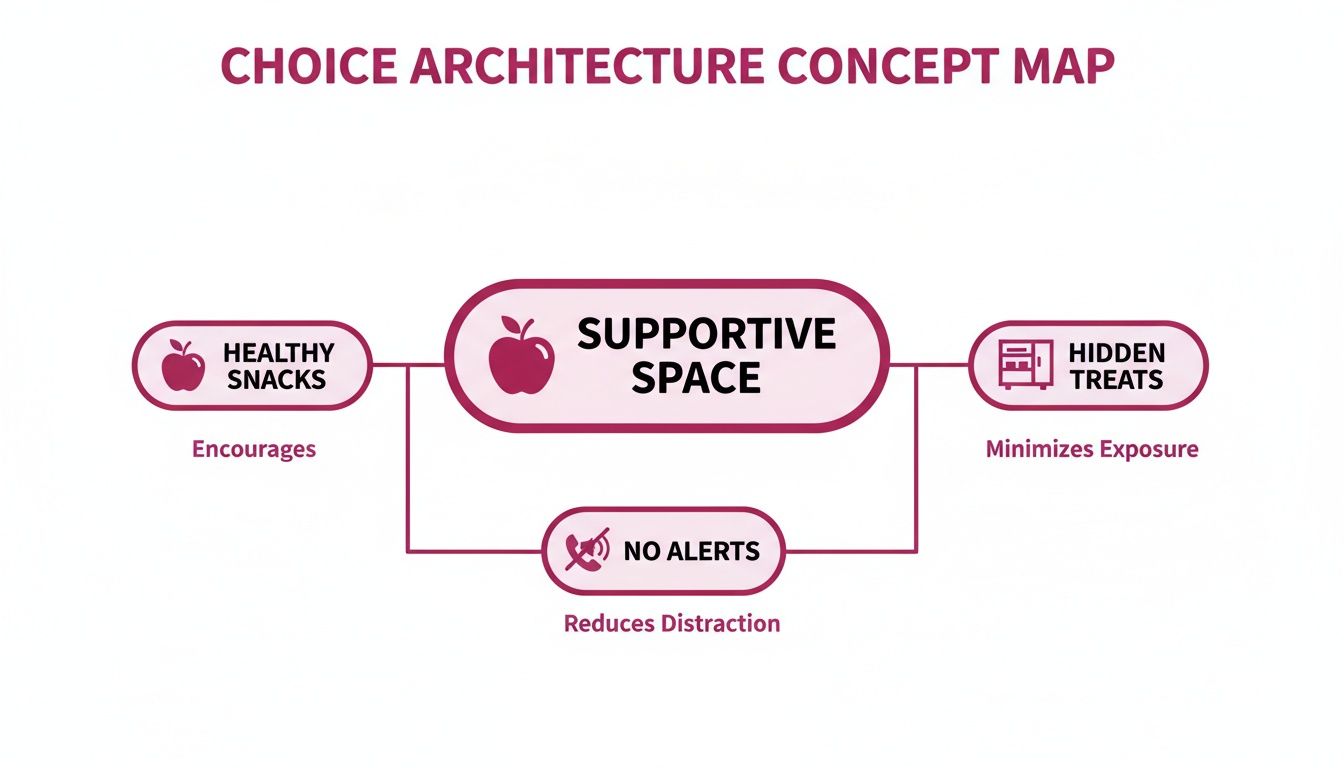
As you can see, creating a supportive space—with healthy food in sight and temptations hidden—works hand-in-hand with the mental muscle you build through regular movement. One makes the right choice easier, and the other makes you stronger at choosing it.
Master the Art of the Strategic Pause
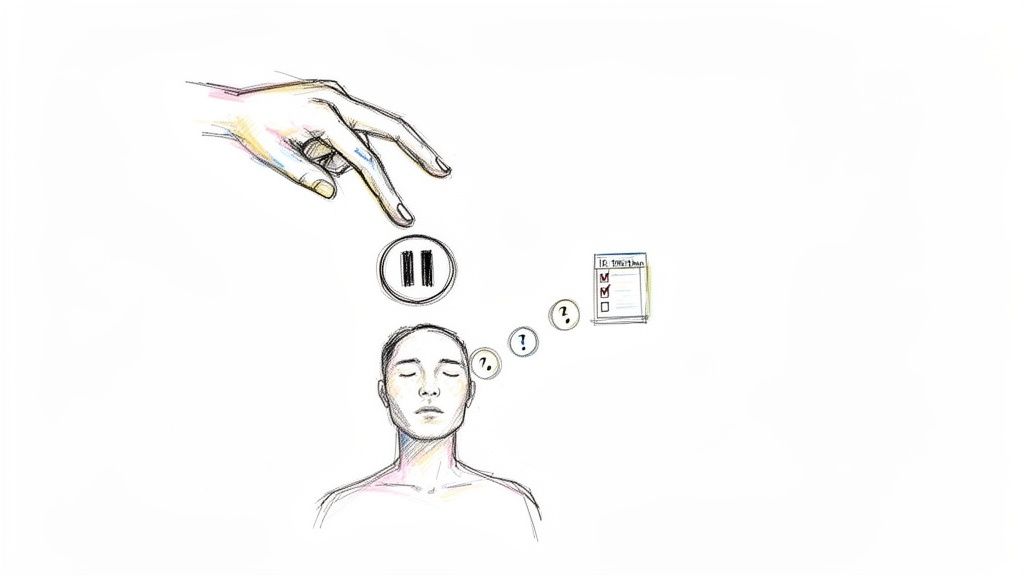
If there's one secret weapon in building impulse control, it's the tiny space between feeling an urge and acting on it. Your real power is in your ability to widen that gap, even if only for a few seconds. When you master a strategic pause, you give your thinking brain—your prefrontal cortex—a fighting chance to catch up with your reactive, emotional brain.
This doesn't mean you need to drop into a full meditation session every time a craving strikes. It can be as simple as taking three slow, deliberate breaths. The moment you feel that pull toward the pantry, just stop. Inhale deeply, hold it for a count of four, and then exhale slowly. That tiny action is often enough to interrupt the automatic habit loop and calm your nervous system, pulling you out of that feeling of urgency and into a state of awareness.
Create Your Go-To Pause Techniques
When an impulse hits hard, you won't have time to think up a strategy. That's why having a few go-to pause techniques ready is so important. The trick is to find something that feels natural to you—something you'll actually do when you're feeling stressed or tempted.
Here are a few proven techniques I've seen work for countless people:
- The 5-Second Rule: This one is brilliant in its simplicity. The instant you feel an urge, just start counting down from five in your head. 5... 4... 3... 2... 1. It sounds almost too easy, but that small delay can be just enough to break the impulse’s spell and give you a moment to ask, "Is this what I really want?"
- Change Your Scenery: If you can, physically move. If you're standing in the kitchen staring into the fridge, get up and walk into another room or step outside for a minute. A physical shift often creates a mental shift, too.
- Sip a Glass of Water: This classic trick serves two purposes. It forces a pause, giving you a moment to check in with your body. It also helps you figure out if you're actually thirsty instead of hungry or bored.
Every time you practice one of these small pauses, you're not just delaying the impulse. You're actively re-wiring your brain. You're strengthening the neural pathways for self-regulation, making it a little bit easier to manage the next impulse, and the one after that.
Plan for Your Triggers with If-Then Scenarios
Pausing in the moment is a reactive skill, but you can also get proactive. This is where creating "if-then" plans can be a complete game-changer. Based on the trigger patterns you've already identified, you can map out a specific, pre-planned response for when you're most vulnerable.
An if-then plan is simple. It looks like this: "If I feel that wave of boredom and restlessness hit after work, then I will put on my favorite podcast and walk around the block for 10 minutes."
By setting up these simple rules for yourself ahead of time, you take the guesswork out of the equation. You remove the need to make a tough decision when your willpower is already running on fumes. You've already made the choice; now all you have to do is follow your own script.
You can use the journaling feature in Superbloom to create and keep track of these plans. Make a list of your top triggers, and then brainstorm a healthier "then" for each one. This one-two punch of practicing the pause and having a backup plan is how you start turning mindless, reactive habits into mindful, intentional decisions.
Building a Life of Intentional Choices
Think of improving your impulse control less like reaching a final destination and more like learning a new skill. It’s something you cultivate, one small, deliberate action at a time. This entire journey is built on the simple, consistent practice of noticing your triggers, setting up your environment for success, moving your body, and mastering that crucial pause before you act.
These aren't tests of willpower; they're practical tools for your toolbox.
Every single time you make a mindful choice, you’re quite literally strengthening the neural pathways that make the next one easier. It creates this incredible ripple effect. You’re slowly but surely teaching yourself how to respond to your body's signals with intention, rather than just reacting on autopilot.
The goal is never perfection, but progress. You are building a more thoughtful and satisfying relationship with your choices, empowering yourself one small change at a time.
For anyone looking to go deeper into self-regulation, especially where it intersects with neurodiversity, exploring resources on how to manage ADHD without medication can provide a really helpful framework.
The most important thing is to just start. Pick one manageable change you can make today. Acknowledge your wins, get curious about your patterns, and keep laying the foundation for a more intentional life.
Your Questions About Impulse Control, Answered
As you start working on impulse control, questions are bound to pop up. It’s a journey, after all, and it's totally normal to wonder about timelines, setbacks, and how digital tools can actually make a difference. Let's get into some of the most common things people ask.
How Long Until I Actually See a Difference?
This is the big one, and the real answer is, it’s different for everyone. There’s no universal timeline, but you can definitely expect to notice small but important shifts within a few weeks of consistent effort. The first major win usually isn't perfect self-control; it's sharpened awareness. You'll start catching that split-second moment before you act.
Building new neural pathways and making those changes stick can take several months. Think of it like physical fitness. You don’t get a six-pack after one trip to the gym, but every workout builds strength. The trick is to focus on the small wins—like noticing you paused for three seconds before reaching for the cookie jar—instead of holding out for some mythical "perfect" day.
What if I Have an Off Day and Revert to Old Habits?
Let’s be clear: slip-ups aren’t just possible, they are a completely normal and expected part of the learning process. One impulsive decision doesn't wipe out all the progress you've made. The goal here isn't a flawless record; it’s about building resilience.
When a setback happens, your best move is to get curious, not critical. Instead of beating yourself up, just ask, "Okay, what was the trigger here?" or "What was I feeling right before that happened?" This simple shift turns what feels like a failure into incredibly valuable data for your next "if-then" plan.
Can an App Genuinely Help, or Is It Just More Screen Time?
That's a very fair question. The key is finding the right kind of app—one that works as a support tool, not another digital distraction. A thoughtfully designed app like Superbloom is grounded in behavioral psychology, making it much easier to put the strategies we've talked about into practice.
It helps by streamlining the work of:
- Tracking Triggers: Quick check-ins let you log your emotions and the situation right when it happens, revealing patterns you'd probably miss otherwise.
- Practicing Pauses: Just the simple act of opening an app to log an urge forces a natural, strategic pause between the feeling and the action.
- Reinforcing Progress: Seeing your successful moments and insights laid out visually reinforces your new habits. It helps make change feel encouraging instead of like a constant struggle.
It’s really about using technology to make self-awareness and skill-building more accessible, not to add another layer of stress to your day.
Ready to turn awareness into action? Superbloom combines personalized AI coaching with psychology-backed tools to help you build healthier habits that last. Start your journey to more intentional eating by downloading the app at https://superbloomapp.com.