
How to Stop Binge Eating Made Simple

If you're trying to stop binge eating, the first step isn't another diet. It’s about stepping away from restriction altogether and getting curious about what’s really going on. Real, lasting change doesn’t come from sheer willpower; it comes from building new skills—like recognizing your triggers and eating in a more structured, mindful way. This is how you move from a cycle of shame and guilt to a place of understanding and empowerment.
Understanding Why You Binge Eat And How to Heal
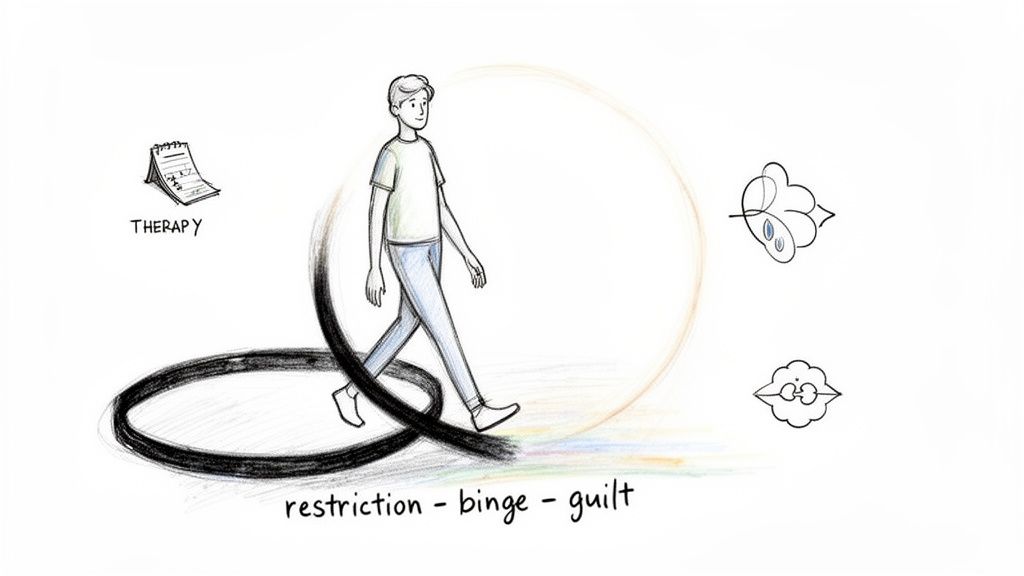
If you feel trapped in a cycle of binge eating, the most important thing to hear is this: it is not your fault. For far too long, binge eating was chalked up to a simple lack of self-control. That outdated view only fueled shame and stopped people from getting the help they needed and deserved.
Thankfully, things started to shift in 2013 when binge eating disorder (BED) was officially recognized as a distinct health condition. This was a huge step, confirming what millions of people already knew firsthand—binge eating is a complex and treatable issue with deep biological, emotional, and environmental roots. You are definitely not alone in this.
Moving Beyond the Binge-Restrict Cycle
At its heart, binge eating is often locked in a vicious cycle with restriction. When you severely limit what or how much you eat, your body’s powerful survival instincts take over. This triggers intense cravings and an overwhelming, primal urge to eat that can feel impossible to fight.
Then, after a binge, the guilt and shame come crashing down, which often leads right back to stricter rules and more restriction. And so the loop continues, with each attempt to "be good" actually fueling the next binge. The solution isn't more willpower; it's breaking this cycle for good.
The path to stop binge eating isn't about fighting your body with more rules. It's about learning to work with it by providing consistent nourishment, managing emotional triggers, and building self-compassion.
A New Framework for Healing
Instead of obsessing over what not to eat, a much more effective approach is to build new skills and gently shift your mindset. It’s a process of moving from self-blame to self-awareness, and there are proven, evidence-based strategies that can guide you.
Many people try to tackle binge eating with the same tools they'd use for dieting—rules, restrictions, and willpower. But this often backfires. A more sustainable path involves building awareness and developing new coping skills.
Here’s a look at how these two approaches differ:
Shifting Your Mindset From Restriction to Awareness
Common Approach (Restriction)Effective Strategy (Awareness & Skill-Building)Focuses on eliminating "bad" foods.Focuses on understanding why urges happen.Relies on willpower and strict rules.Teaches emotional regulation and coping skills.Often leads to a cycle of guilt and shame.Promotes self-compassion and curiosity.Sees a binge as a failure.Views a binge as a learning opportunity.Promises a quick fix.Builds sustainable, long-term habits.
By shifting your focus from controlling food to understanding yourself, you can start to build a healthier, more peaceful relationship with eating.
Here are some of the most effective, evidence-based strategies that help make this shift happen:
- Cognitive Behavioral Therapy (CBT): This is the gold standard for a reason. CBT helps you spot and challenge the negative thought patterns that trigger binges. It gives you practical, real-world tools to change how you respond to stress and difficult emotions.
- Mindful Awareness: This practice is about learning to slow down and simply notice your urges without judging them. Instead of reacting on autopilot, you create a small but powerful pause between a feeling and an action. That pause is where you get your power back.
- Structured Eating: Adopting a flexible but consistent eating pattern is key. It helps stabilize your blood sugar and dials down the intense, biological hunger that so often kicks off a binge. This is how you begin to rebuild trust between your mind and your body.
And the research backs this up. Tailored cognitive behavioral therapy has shown remission rates of up to 50% in clinical trials. Even the simple act of tracking your patterns can slash binge frequency by 30-40% in just a few weeks. You can find more insights into recovery statistics from The Alliance for Eating Disorders Awareness.
Healing isn’t a battle to be won. It's a process of learning new skills. By understanding the real drivers behind binge eating and applying these proven strategies, you can reclaim your life and finally find peace with food.
Your First Action Step: Identifying Personal Binge Triggers
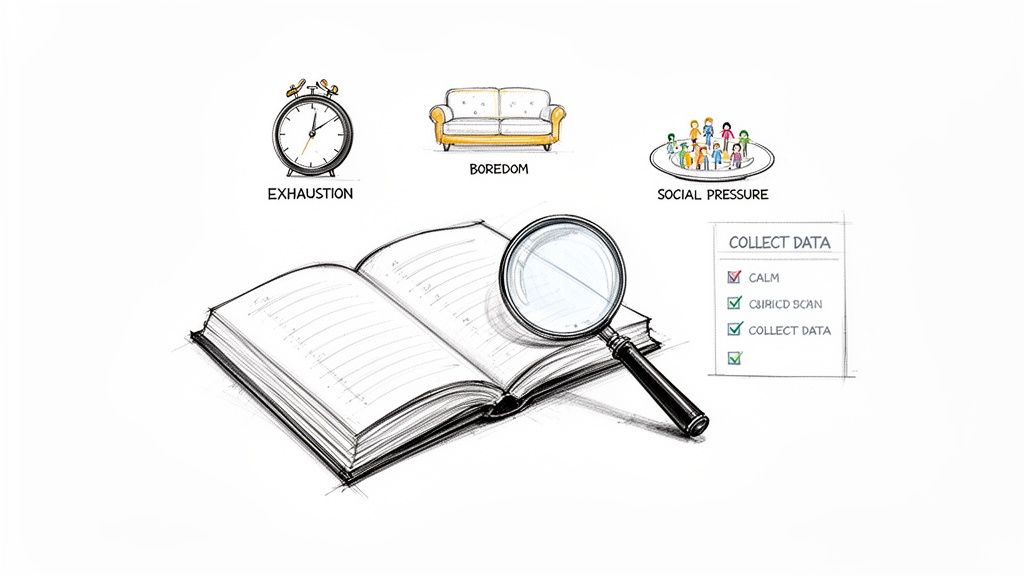
Before you can build a new set of coping skills, you have to know what you’re actually coping with. Binge eating rarely happens in a vacuum. It’s almost always a reaction to something specific—a feeling, a situation, a thought. This is where you put on your detective hat and start looking for clues, without any judgment.
The goal here isn't to criticize yourself; it's simply to collect data. Think of yourself as a scientist observing a phenomenon. By pinpointing the specific situations, feelings, or even times of day that come right before a binge, you give yourself the power to step in and change the pattern.
The Different Faces of Binge Triggers
While your triggers are unique to you, they usually fall into a few common categories. Seeing these buckets can help you start connecting the dots in your own life.
You might even notice that your triggers are a mix of different factors. For instance, a stressful day at work (emotional) leaves you feeling drained, so you decide to stay home alone (environmental), which sets the stage for a binge in the evening (situational).
Common trigger categories include:
- Emotional Triggers: These are feelings that just don't feel good. Stress, anxiety, loneliness, sadness, and even plain old boredom are powerful motivators for using food as a source of comfort.
- Environmental Triggers: Sometimes your surroundings are the culprit. This could be anything from seeing a pizza commercial on TV, walking past your favorite bakery, or even just being in a messy, disorganized kitchen.
- Situational Triggers: Certain events or times of day can be a setup. For many people, it's that unstructured block of time after work or late at night when you're tired and your guard is down. Social events can be a huge situational trigger, too.
- Biological Triggers: As we mentioned earlier, restriction is a massive trigger. If you don't eat enough during the day, your body's intense biological hunger can feel completely indistinguishable from an emotional urge to binge.
Your Tool for Discovery: A Judgment-Free Journal
Honestly, the most powerful tool you have for figuring this all out is a simple journal. This isn't about meticulously logging calories or making yourself feel guilty. It's about taking quick, factual notes when you feel an urge or just after a binge has happened.
The whole key is to approach this with genuine curiosity, not criticism. Every entry is just a piece of data that helps you see the bigger picture more clearly.
Think of your journal as your evidence log. It’s not a record of your failures; it’s a map that reveals the path out of the cycle. Each entry illuminates a connection you couldn't see before.
You can use a notebook, the notes app on your phone, or a guided platform like the Superbloom app that walks you through check-ins. The specific tool doesn't matter nearly as much as just doing it consistently.
What to Actually Write Down
To make this truly useful, focus on capturing the context around the binge or the urge. You don't need to write a novel. Just jot down quick answers to a few key questions. It shouldn't take more than a minute or two.
Here are the specific prompts I recommend using:
- What was I feeling right before the urge hit? Try to be specific. Instead of just "bad," could you name the emotion? Was it lonely? Overwhelmed? Frustrated? Bored?
- What just happened in the last hour? Did you get off a tense call with your boss? Did you just get home from a draining commute? Were you mindlessly scrolling Instagram?
- Where was I, and who was I with? Note your physical location (in the kitchen, in my car, at my desk) and whether you were alone or with other people.
- What time of day was it? Patterns often stick to a schedule, like that mid-afternoon slump or late at night when everything feels harder.
- How hungry was I on a scale of 1-10? This is crucial for helping you tell the difference between true, biological hunger and a purely emotional urge.
After just a week or two of this, you can look back and the patterns will start to jump out at you. Maybe you'll see that binges almost always happen after video calls with a certain family member, or that an unstructured Saturday afternoon is your biggest danger zone. This is the foundational knowledge you need to start building a real, personalized plan to break free.
Building a Flexible and Structured Eating Framework
If you truly want to stop binge eating, you have to start by breaking the cycle that feeds it: restriction. It’s a classic trap. When you deprive your body of consistent energy, its primal survival instincts take over, unleashing intense biological cravings that feel almost impossible to fight.
The answer isn't more willpower or a stricter set of rules. It’s about rebuilding trust with your body through a flexible, structured eating framework. Think of it less like a diet and more like a peace treaty with your body.
The whole point is to prove to your body that it will be consistently nourished. This simple act helps stabilize your blood sugar, quiets the constant mental chatter about food, and dramatically turns down the volume on those overwhelming urges to binge. You're using structure as a tool for freedom, not another cage.
The Power of Mechanical Eating
A fantastic way to start is with a concept called mechanical eating. It sounds a bit robotic, but the idea is simple: you eat by the clock, not by your hunger cues.
For many people stuck in the binge-restrict cycle, those internal signals for hunger and fullness have gone haywire. They’re just not reliable anymore. Mechanical eating helps you hit the reset button.
The initial goal is pretty straightforward. Aim for three meals and one or two snacks, spaced roughly three to four hours apart. This rhythm keeps your blood sugar from plummeting—a major physiological trigger for bingeing. In the beginning, you might find yourself eating when you don't feel particularly hungry, and that's perfectly okay. You're in a retraining phase, teaching your body and brain to expect and receive fuel consistently.
So, What Does a Structured Meal Actually Look Like?
"Structured" doesn't have to mean boring or bland. It just means balanced and satisfying. To head off the physical and psychological deprivation that so often leads to a binge, every meal should be built to keep you feeling full and energized.
A simple formula that works wonders is combining three key components:
- Protein: This is your satiety superstar. Including things like chicken, fish, tofu, beans, or Greek yogurt helps you feel fuller for much longer.
- Fiber: Found in fruits, veggies, and whole grains, fiber adds bulk to your meals and helps slow down digestion, keeping your energy levels nice and steady.
- Healthy Fats: Sources like avocado, nuts, seeds, and olive oil don't just add flavor and essential nutrients; they play a huge role in feeling truly satisfied after you eat.
When you bring these three elements together, you create a meal that truly addresses your body's needs. This makes it far less likely you'll experience that ravenous, out-of-control hunger that often sets the stage for a binge.
Real-World Examples of a Flexible Framework
Putting this all into practice is probably simpler than you think. It's about consistency, not perfection.
Here’s a glimpse of what a day could look like.
Sample Day Structure:
- Breakfast (7:30 AM): Scrambled eggs (protein/fat) with a slice of whole-wheat toast (fiber) and some avocado (fat).
- Snack (10:30 AM): An apple (fiber) with a small handful of almonds (protein/fat).
- Lunch (1:00 PM): A big salad loaded with grilled chicken (protein), lots of different veggies (fiber), chickpeas (protein/fiber), and a simple vinaigrette (fat).
- Snack (4:00 PM): Greek yogurt (protein/fat) with a handful of berries (fiber).
- Dinner (7:00 PM): Baked salmon (protein/fat) served with roasted broccoli (fiber) and quinoa (fiber/protein).
Remember, this is just a template, not a strict rulebook. The magic is in the rhythm of eating regularly and the balance of nutrients—not the specific foods. If you can't stand salmon, swap it for something you actually enjoy. The goal here is nourishment, not punishment.
This entire approach works because it systematically dismantles the main biological driver of binge eating: deprivation. When you provide your body with predictable, balanced energy, you calm its panicked survival response. Over time, those intense, desperate urges start to soften because your body finally learns it no longer needs to scream for fuel. This foundation of physical stability is absolutely essential before you can effectively work on the emotional side of things.
Practical Ways to Navigate Binge Urges in the Moment
When an intense urge to binge hits, it can feel like a tidal wave—sudden, powerful, and completely overwhelming. In that moment, trying to fight it head-on with willpower is an exhausting, and often losing, battle. A much more effective approach is learning to "urge surf," a mindfulness technique that teaches you to ride the wave of the urge until it naturally subsides, without getting swept away.
The key is to remember that urges are temporary. They rise, peak, and then fall, just like a wave. Your goal isn't to crush the wave but to stay on your surfboard until it passes. This means having a toolkit of immediate, actionable strategies ready to go, creating that crucial pause between feeling and action.
Create a Pause with the 5-4-3-2-1 Method
When an urge feels all-consuming, it’s usually because you're stuck in your head, caught in a spiral of anxious thoughts. The best way to break that loop is to pull your attention back into your body and your immediate surroundings with a grounding exercise.
The 5-4-3-2-1 method is perfect for this. It's simple, discreet, and forces you to engage your senses.
- 5: Name five things you can see around you. Look for small details you might normally ignore—the texture of a wall, a speck of dust on the table, the way light hits a plant.
- 4: Acknowledge four things you can feel. This could be the sensation of your feet on the floor, the fabric of your clothes, or the cool surface of a desk.
- 3: Listen for three things you can hear. Tune into the hum of the refrigerator, the distant sound of traffic, or the rhythm of your own breathing.
- 2: Identify two things you can smell. Maybe it's the faint scent of coffee in the air or the soap on your hands.
- 1: Name one thing you can taste. Notice the lingering taste from your last drink or simply the neutral taste inside your mouth.
This exercise effectively short-circuits the panic response by redirecting your brain's focus. It creates just enough mental space to breathe and choose your next action intentionally, rather than reacting on autopilot.
Use Delay and Distraction Strategically
Sometimes, the best thing you can do is put some time and space between yourself and the urge. This isn't about ignoring the feeling forever; it's about proving to yourself that you don't have to act on it right now. A simple timer can be an incredibly powerful tool for this.
The next time an urge strikes, try telling yourself, "Okay, I can have that, but not for 15 minutes." Then, set a timer and immediately turn your attention to a pre-planned activity from your "distraction list." This needs to be something that actively engages your mind or body, not just mindless scrolling.
Your list could include things like:
- Calling a friend to talk about something totally unrelated.
- Putting on a high-energy playlist and dancing for three songs.
- Solving a puzzle like a Sudoku or crossword.
- Stepping outside for a five-minute walk around the block.
When difficult emotions and thoughts are fueling these urges, tools like a cognitive therapy thought record can also be incredibly helpful for building the self-awareness needed to break the cycle.
By the time the timer goes off, you’ll often find the intensity of the urge has decreased significantly, giving you a renewed sense of control.
The goal of delaying isn't to punish yourself. It's to prove that an urge is just a feeling, not a command. You are always in the driver's seat.
Think of it this way: having a stable foundation makes it easier to weather these storms. A structured meal plan is one such foundation.
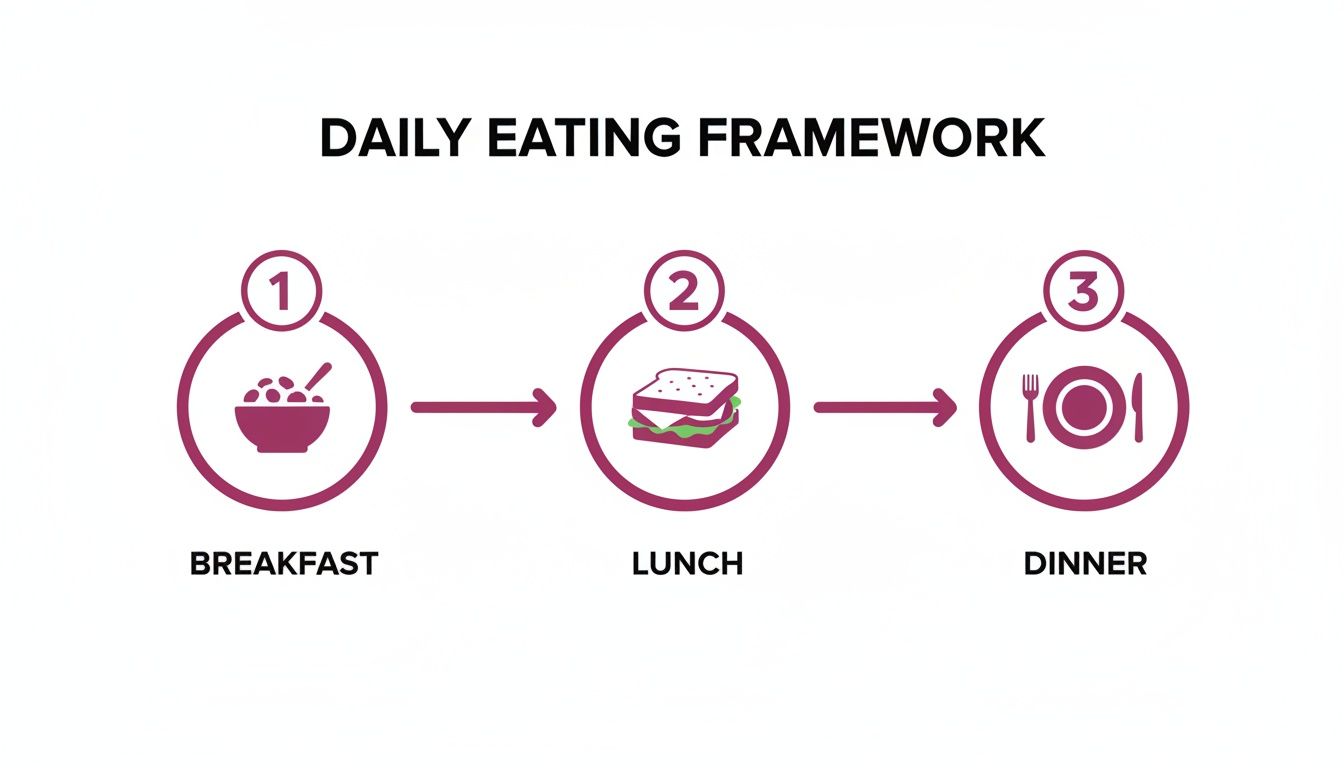
When your body is consistently nourished, you avoid the extreme biological hunger that can make emotional urges feel ten times stronger.
These in-the-moment skills aren't about achieving perfection. They are about building a toolkit of options so that when an urge strikes, you have somewhere to turn besides food. Each time you successfully navigate an urge, you strengthen that new neural pathway, making it easier and more automatic the next time.
Learning to Ride the Emotional Waves
Let's be honest: binge eating usually isn't about food at all. It’s often a desperate attempt to cope when emotions like stress, sadness, or loneliness feel completely overwhelming. Food can seem like a quick fix, a temporary shield from an internal storm. A huge part of learning how to stop binge eating is building a brand new toolkit for navigating these feelings without turning to food.
This isn't about ignoring or stuffing down your emotions. Quite the opposite. It's about learning how to sit with them, listen to what they're trying to tell you, and respond with kindness instead of reacting with a binge. Think of it as building your emotional resilience and learning to be your own best ally.
Simple Ways to Calm Your System
When a big emotion hits, your body can go into a fight-or-flight response, making it nearly impossible to think clearly. The trick is to have some simple, body-based techniques ready to go. These can calm your nervous system and give you just enough breathing room to make a different choice.
Here are two of my go-to practices you can do literally anywhere:
- Box Breathing: It's as simple as it sounds. Inhale for a slow count of four, hold for four, exhale for four, and hold again for four. This rhythmic breathing breaks the panic cycle and sends a powerful "all clear" signal to your brain.
- Progressive Muscle Relaxation: Start with your toes. Tense them up for about five seconds, then let all the tension go. Slowly work your way up your body—feet, calves, thighs—tensing and releasing each muscle group. It’s an incredibly effective way to pull your focus out of your head and back into your body.
Getting a handle on intense feelings is a game-changer. For a deeper dive, check out these powerful emotional regulation strategies for adults to expand your toolkit.
Choose Self-Compassion, Not Self-Criticism
The moments right after a binge can be brutal. They're often filled with shame and a harsh inner critic telling you all the things you did wrong. This negativity is rocket fuel for the binge-shame cycle, often leading right back to another binge.
The way out? Self-compassion.
This isn’t about letting yourself off the hook. It’s about treating yourself with the same kindness you’d give to a friend who was struggling. It means acknowledging your pain without piling on the judgment and remembering that we all stumble.
Self-criticism asks, "What's wrong with me?" Self-compassion asks, "What do I need right now?" Shifting this internal question is the key to breaking the cycle of shame.
And this isn't just a nice idea—it's backed by evidence. Behavioral therapies that focus on emotional triggers and self-kindness have been shown to lead to a 60-70% reduction in symptoms after just one year. You can explore the findings on BED recovery statistics to see the data for yourself.
Journal Prompts to Go Deeper
Journaling can be an incredible tool for building emotional awareness and self-compassion. It gives you a safe space to untangle your feelings and gently challenge that inner critic. Instead of just tracking what you ate, try using these prompts to connect with what’s really going on inside.
The next time an urge hits, or you're reflecting after a binge, grab a notebook and explore these questions:
- If my best friend felt this exact same way, what would I say to them? This question is a shortcut to your own innate kindness—it just helps you point it in the right direction.
- What do I truly need right now that isn't food? Is it a nap? A hug? Five minutes of silence? Just naming the real need is the first step toward actually meeting it.
- What is one small, kind thing I can do for myself in the next 10 minutes? It doesn't have to be big. Maybe it’s stretching, putting on a favorite song, or just stepping outside for a breath of fresh air.
Knowing When and How to Seek Professional Support
The self-help strategies in this guide can be incredibly powerful, but there are times when trying to go it alone isn't enough. Recognizing when to bring in a professional is not a sign of weakness—it's a brave and crucial step toward lasting recovery.
If binge eating is causing you significant distress, getting in the way of your work or relationships, or if you're also struggling with things like depression or anxiety, that's a clear signal it’s time to get more support. You don't have to carry that weight by yourself.
Finding the Right Professional Help
Figuring out who to see can feel a bit overwhelming, so let's break it down. Think of it as building your own personal support team, where each person brings a unique skill to the table.
Your team might include a few key players:
- A Therapist or Counselor: This is the person who will help you dig into the why behind the bingeing. They can help you untangle the emotional triggers and thought patterns that keep you stuck. Look for someone experienced in approaches like Cognitive Behavioral Therapy (CBT), which is fantastic for giving you concrete tools to change your behaviors.
- A Registered Dietitian (RD): A dietitian who specializes in eating disorders is essential for healing your relationship with food itself. They won't just give you a meal plan; they’ll help you rediscover what it feels like to eat normally, without the rigid rules and restrictions that often fuel the binge cycle.
- A Medical Doctor: Don't forget your primary care doctor. It's always a good idea to keep them in the loop to monitor your physical health and make sure there aren't any underlying medical issues contributing to what you're experiencing.
Seeking help is a profound act of self-care. It means you are willing to give yourself the resources and support you need to build a life free from the cycle of binge eating.
When you're looking for the right person, don't be afraid to interview them. A good fit is everything. Ask about their direct experience with binge eating, what their approach is, and what you can expect from working with them. Taking this step is a powerful investment in your future well-being.
Your Binge Eating Questions, Answered
As you start working on your relationship with food, it's completely normal for questions to pop up. Let's tackle some of the most common ones that come up on the path to recovery.
Is This a Binge, or Did I Just Overeat?
This is a really important distinction, and it’s one I get asked all the time. Think of it this way: most of us have overeaten at some point. Maybe it was an extra helping at Thanksgiving or another slice of pizza with friends. You might feel a bit stuffed, but it's usually a conscious choice and doesn't come with a heavy emotional fallout.
A binge is a whole different experience. The defining feature is a feeling of being completely out of control. It's not just about the amount of food, but the frantic, almost disconnected way it’s consumed, often in secret and until you're uncomfortably full. The real kicker is the wave of shame, guilt, and distress that hits afterward. That’s the key difference.
How Long Does Recovery Take?
If I had a dollar for every time someone asked this, I'd be retired! The honest answer is: it's different for everyone. There’s no universal timeline or finish line. For some, big shifts can happen in a few months. For others, it’s a longer road with more twists and turns.
The real goal isn't to get to a mythical "cured" date on the calendar. It’s about building a toolkit of sustainable skills. You're learning to spot your triggers, nourish your body consistently, and find better ways to handle tough emotions. Every time you do that, you're making progress, and that’s what matters.
Recovery isn't a straight line. Bumps in the road are part of the journey, not a sign that you've failed. See them as a chance to learn and come back to your plan with a little more kindness for yourself.
What Do I Do If I Have a Relapse?
Okay, first things first: take a deep breath. A relapse—bingeing after a period of not bingeing—can feel like a massive setback, but it absolutely does not wipe out all the hard work you've put in. The biggest mistake you can make right now is letting shame take over, because that shame is what powers the binge cycle.
Instead, try to get curious. Think like a detective. Pull out your journal and ask yourself some gentle questions about what was going on.
- Did I skip a meal earlier in the day?
- Was I dealing with something especially stressful?
- Was I feeling isolated, bored, or angry?
When you look at the situation without judgment, a relapse transforms from a failure into valuable feedback. It’s just data. Use that information to tweak your strategies and keep moving forward.
Ready to put these ideas into practice? Superbloom provides a supportive space to explore your patterns and build a healthier relationship with food. Through daily check-ins and personalized feedback, you can start creating lasting change. Learn more and begin your journey at Superbloom.