
Your Intuitive Eating Guide to Ending Diets for Good
Think of it like this: you were born with an internal compass that perfectly guided your body's needs. But after years of following rigid, often conflicting diet maps, that compass has been thrown completely out of whack. Intuitive eating is the process of getting that compass back in your own hands and learning to trust it again.
It’s a self-care framework that helps you finally tune back into your body’s natural hunger and fullness signals, giving you a way to step off the exhausting diet rollercoaster for good.
What Is Intuitive Eating and Why It Matters Now
At its heart, intuitive eating is about rejecting the outside noise of diet culture and learning to trust your own body's wisdom. Instead of obsessing over calories or slapping "good" and "bad" labels on food, you learn to listen to what your body is actually telling you. It's a fundamental shift away from a mindset of restriction and toward one of genuine self-respect.
This isn't some new-age fad. It's an evidence-based model developed years ago by dietitians Evelyn Tribole and Elyse Resch. We're seeing it gain so much traction now because people are tired of health solutions that only focus on shrinking their bodies at the expense of their mental well-being. The goal here isn't weight loss; it's finding peace with food.
The Problem With Diet Culture
For decades, we’ve been sold the idea that health is something you achieve by controlling and punishing your body with strict rules. The diet industry, a massive business, actually depends on a staggering 95% failure rate. It succeeds by convincing you that you are the one who failed, not the diet itself.
This creates a vicious and destructive cycle that so many of us know all too well:
- Restriction: You start a new diet, cutting out foods or drastically reducing calories.
- Deprivation: Your body and mind inevitably feel deprived, which sparks intense cravings for the very things you're not "allowed" to have.
- Overeating: You finally "give in," often eating far past the point of comfortable fullness because you don't know when you'll "let" yourself have this food again.
- Guilt and Shame: A wave of shame washes over you. You feel like a failure, which only reinforces the belief that you need an even stricter diet to get back in control.
Intuitive eating dismantles this entire cycle by taking away the first step: restriction. When you give yourself unconditional permission to eat all foods, the psychological power of "forbidden" foods starts to lose its grip.
Intuitive eating is a non-diet approach that can be considered a specialized form of nutrition therapy, guiding individuals toward a healthier relationship with food. It empowers you to become the expert of your own body.
The Evidence for a New Approach
The case for ditching the diet mentality for good is incredibly strong. A huge 2023 study of 6,272 emerging adults across eight different countries found that higher levels of intuitive eating were directly linked to better body satisfaction, higher self-esteem, and a lower Body Mass Index (BMI).
On the flip side, the study showed that restrained eating—the pattern of chronic dieting—was correlated with poorer body image and lower self-confidence. The science is clear: learning to work with your body, not against it, has profound benefits.
This guide will walk you through the core principles and the science behind why this approach works. More importantly, we'll cover the practical steps you can take to start this journey. It’s about so much more than what you eat; it’s about fundamentally changing how you think and feel about food, your body, and yourself.
The 10 Principles of Intuitive Eating Unpacked
To really get started with intuitive eating, we need to dig into its 10 core principles. These aren't another set of rigid rules to follow. Instead, think of them as compassionate guideposts, developed by dietitians Evelyn Tribole and Elyse Resch, to help you find your way back to your body's own internal wisdom.
Consider this your roadmap for unlearning a lifetime of diet culture and finally rebuilding trust with yourself. We’ll walk through each one, starting with the basics and building from there.
1. Reject the Diet Mentality
This is the first, and honestly, the most critical step. You have to get rid of the belief that the next diet will be the one that finally works. It won’t.
Imagine your brain is a smartphone cluttered with old diet apps—the calorie counters, the food trackers, the weight-loss programs. Each one promised a quick fix, but they all just drained your battery and left you feeling worse. This first principle is about hitting "delete" on all of them. It’s about getting angry at the lies diet culture has sold you for years.
The diet industry has a dirty secret: it relies on a staggering 95% failure rate. It’s designed for you to fail so you keep coming back, blaming yourself instead of the broken system. It's time to recognize that diets failed you, not the other way around.
2. Honor Your Hunger
Think of your hunger cues like your car’s gas gauge. You wouldn’t wait until the tank is completely empty and you're stranded on the side of the road to refuel. You’d fill up when the gauge starts dipping low. It's the same with your body.
Honoring your hunger means listening to its early, gentle signals before it escalates into that primal, can’t-think-about-anything-else urgency. Dieting teaches us to fear or ignore hunger, but it’s just a normal biological signal. When you consistently give your body the energy it asks for, it learns to trust you again. That trust is what finally quiets the intense biological drive to overeat that comes from long periods of restriction.
This is all about shifting from following external rules (a rigid, confusing map) to trusting your internal cues (your own personal compass).
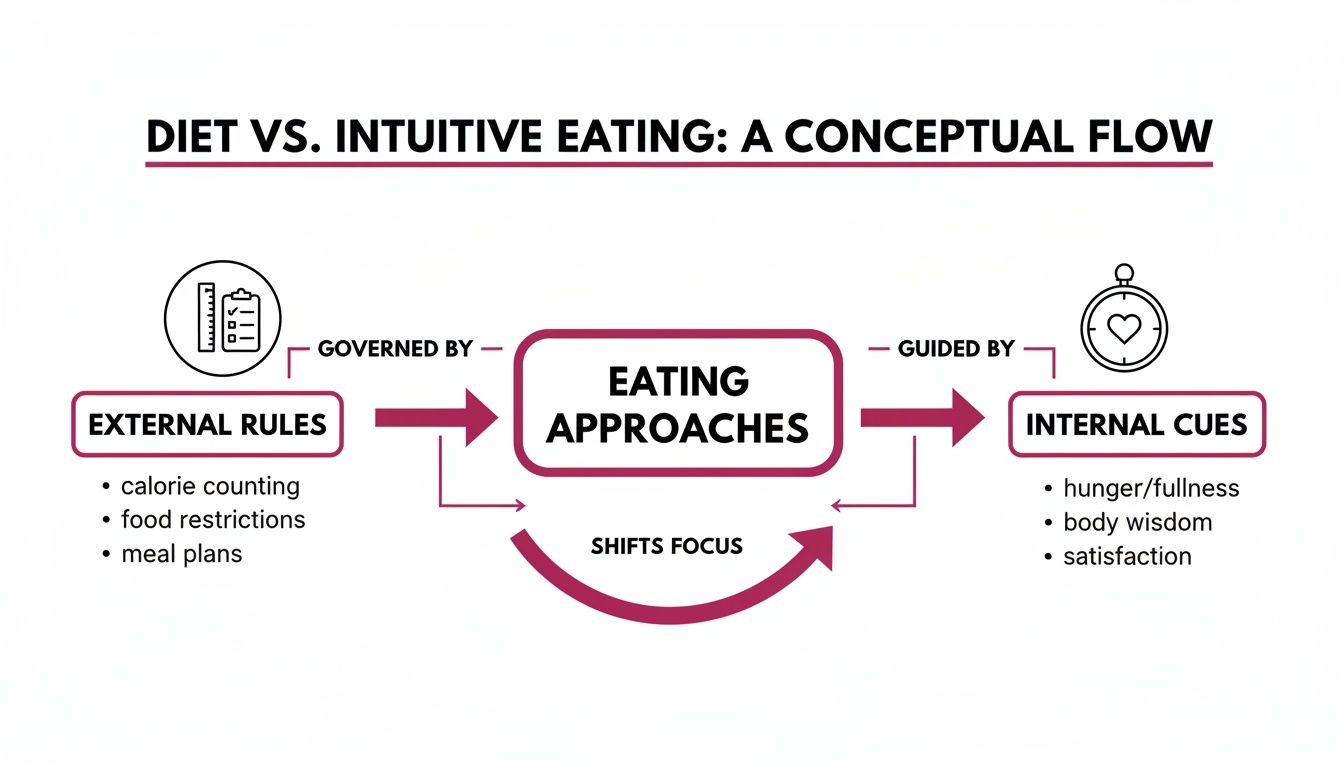
As you can see, dieting forces you to outsource your decisions. Intuitive eating brings that power right back where it belongs: with you.
3. Make Peace with Food
This next step involves giving yourself unconditional permission to eat all foods. No strings attached. The second you label a food as "bad" or "off-limits," you put it on a pedestal and give it way too much power over you. It’s like telling a toddler, "Whatever you do, don't touch that shiny red button." What's the first thing they're going to do?
When you truly allow all foods back into your life, the intense cravings and that "last supper" feeling—where you eat as much as you can because you're starting a diet tomorrow—start to disappear. This process is called habituation. The forbidden food loses its allure because you know you can have it whenever you want. A cookie is just a cookie, not a moral failure.
4. Challenge the Food Police
We all have them. The "food police" are those nagging voices in your head that have memorized every diet rule you've ever read. They're the ones that praise you for eating a salad and scold you for having a slice of cake.
This principle is all about learning to spot that inner critic and talk back. When it says you were "bad" for eating dessert, challenge it. Is one food choice really a reflection of your worth as a person? Of course not. Learning to reframe those judgmental thoughts with neutral, curious ones is a game-changer.
5. Discover the Satisfaction Factor
One of the biggest downsides of dieting is that it often makes us eat food we don’t even like, just because it’s "healthy." Intuitive eating invites you to bring pleasure back to the table.
When you eat what you truly want, in an environment that feels good, you'll likely find that it takes much less food to feel satisfied. That feeling of satisfaction is a crucial piece of the puzzle. It’s what signals to your brain that your needs have been met, helping you feel content and nourished.
6. Feel Your Fullness
Just as it’s important to honor your hunger, it’s equally important to respect your fullness. This is a practice, not a perfect science. It simply means pausing once or twice during a meal to check in with your body.
Ask yourself: How is this food tasting? Am I starting to feel comfortably full? It’s not about finding the "perfect" stopping point, but about building awareness so you can end the meal feeling good, not uncomfortably stuffed.
7. Cope with Your Emotions with Kindness
Let's be real: emotional eating happens. Food can be a quick and easy way to soothe ourselves when we're stressed, bored, or lonely. But it’s a temporary fix that can't solve the underlying feeling.
This principle is about finding kinder ways to comfort and nurture yourself without food being your only tool. It’s about building a whole self-care toolkit. Maybe that means going for a walk, calling a friend, journaling your feelings, or just putting on some music and having a five-minute dance party.
8. Respect Your Body
This can be one of the hardest principles, but it's essential. It's about accepting your genetic blueprint. You wouldn't get mad at a poodle for not looking like a golden retriever, right? So why do we hold our bodies to such a narrow, unrealistic standard?
Respecting your body means treating it with dignity, right now, as it is. It means feeding it, clothing it comfortably, and giving it rest. You don't have to love how your body looks every single day, but you can always choose to respect it.
9. Movement—Feel the Difference
It’s time to uncouple exercise from punishment. Forget burning calories or "earning" your food. Instead, shift your focus to how it feels to move your body.
Movement can become a way to celebrate what your body can do, reduce stress, and boost your energy. Find something you genuinely enjoy, whether that's a walk in the park, stretching on your living room floor, hiking, or dancing. When it feels good, you'll actually want to do it.
10. Honor Your Health with Gentle Nutrition
Finally, we bring nutrition back into the conversation—but without the old rules and rigidity. This is about choosing foods that honor both your health and your taste buds. It’s about what makes you feel good, both physically and mentally.
You don’t need a perfect diet to be healthy. One salad won't make you healthy, and one donut won't make you unhealthy. It's about your patterns over time. The goal here is progress, not perfection, as you find a way of eating that truly nourishes you.
The Science Behind Why Your Body Trusts Intuitive Eating
Intuitive eating isn't just a warm and fuzzy idea—it’s a powerful approach grounded in your body's own biology and psychology. It works because it directly dismantles the toxic restrict-binge cycle that diet culture thrives on.
Think about it: the moment you label a food as "bad" or "off-limits," you're not just setting a rule. You're creating a powerful psychological trigger for deprivation. That feeling is exactly what fuels intense cravings and, eventually, overeating. It's your body's primal fear of famine kicking in, pushing you to get as much of that "forbidden" food as you can while you have the chance. Intuitive eating short-circuits that entire cycle by taking restriction out of the equation.
The Psychology of Habituation
So, how does this actually work in our brains? It comes down to a concept called habituation.
Imagine a new song you love. The first few times you hear it, you crank up the volume and sing along. But after it's been on the radio a dozen times a day for a week, the magic starts to fade. You don't hate it, but the desperate need to hear it is gone.
Food works in the exact same way. When you give yourself unconditional permission to eat a brownie whenever you want one, it slowly transforms. It stops being this forbidden, intensely desirable object and becomes... just a brownie. The novelty wears off, and it loses its power over you. This isn’t a moral failing or a lack of willpower; it's a completely natural and predictable psychological response.
By neutralizing the allure of "forbidden" foods, you let your body’s own wisdom take the lead. You'll start to crave balance not because a diet plan tells you to, but because your body genuinely feels better when it gets a variety of nutrients.
This shift does wonders for your mental health. As people move away from rigid dieting, studies show they experience far less food-related anxiety and obsessive thinking. They reclaim the mental energy they used to spend agonizing over every meal, freeing it up for the rest of their lives.
The Body’s Physical Response to Trust
The benefits aren't just in your head; they show up in your body, too. Chronic dieting often means chaotic eating patterns that send your blood sugar on a wild rollercoaster. But intuitive eating encourages you to listen to your actual hunger and fullness cues, which naturally leads to more regular, balanced meals.
This simple change helps stabilize your blood sugar, giving you more consistent energy and putting an end to those dreaded afternoon crashes.
The research is incredibly clear on this. A 2024 study in Frontiers in Nutrition found that intuitive eating is a measurable protector against being overweight. The research showed that people who were skilled at matching their food choices to their body's needs—a core principle called 'Body-Food Choice Congruence'—had a 43.3% lower chance of being overweight. This connection was found to be true across different cultures, showing just how universal this approach is.
As you start tuning in, you'll also discover which foods help you feel your best. You might notice that certain meals give you a great boost of energy, while others leave you feeling sluggish. For more on this, you can learn how to improve digestive health naturally.
This isn't about creating a new set of food rules. It’s about building a respectful partnership with your body, grounded in your own lived experience. It's a path back to health you can truly trust because it’s guided by the most qualified expert there is: you.
Your First Steps on the Intuitive Eating Path
Alright, this is where the theory ends and your real journey begins. Moving from reading about intuitive eating to actually practicing it is how you'll start to mend your relationship with food. But don't worry, this isn't about getting everything right from day one. It’s about taking small, kind steps toward trusting your body again.
The very first step? Just listen.
After years of outsourcing your eating decisions to diet plans and calorie counts, your body's own signals can feel faint, like a radio station full of static. The goal is to start tuning back in and hearing the whispers of hunger before they become a desperate scream. This is your starting line.
Introducing the Hunger and Fullness Scale
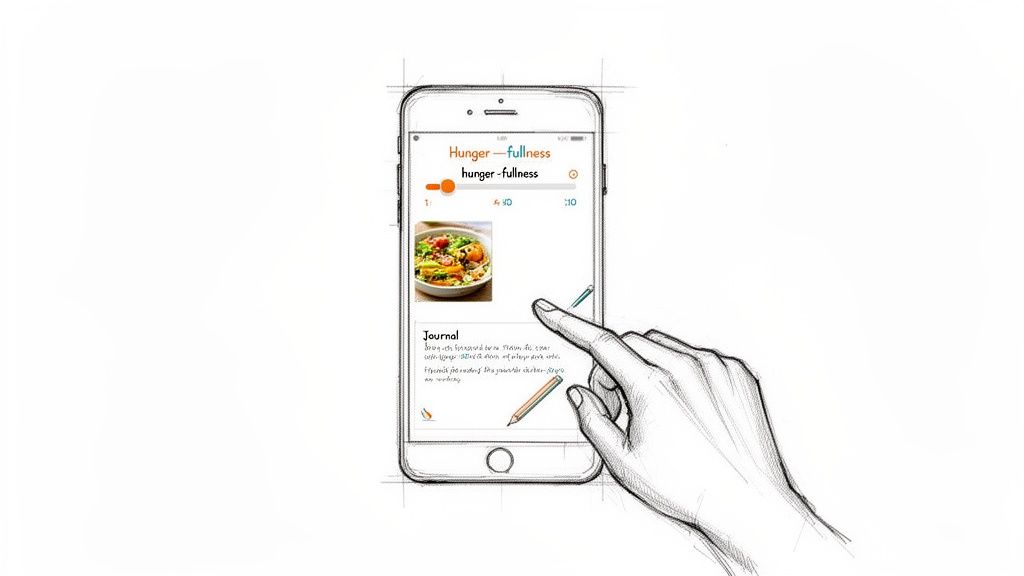
One of the most practical tools you can start with is the Hunger and Fullness Scale. Think of it as a way to translate your body’s physical sensations into a language you can understand. The scale usually runs from 1 to 10, giving you a more nuanced way to describe how you feel beyond just "starving" or "stuffed."
Here’s a common breakdown:
- 1: Painfully hungry, weak, maybe even dizzy. (You've waited too long!)
- 2-3: Very hungry. Your stomach is probably growling, and you feel an urgent need for food.
- 4-5: Gently hungry. You're starting to think about food, and your body is ready for energy. This is often the sweet spot to start a meal.
- 6-7: Comfortably full and satisfied. You feel energized and content, not sluggish. This is a great place to stop eating.
- 8-9: Overly full. You might feel a bit uncomfortable, bloated, or sleepy.
- 10: Painfully stuffed. You feel sick and deeply uncomfortable.
The point isn't to perfectly hit a certain number every single time. Instead, use the scale to simply check in with yourself—before, during, and after you eat. For many, the goal becomes starting to eat around a 4 or 5 and stopping at a 6 or 7.
Trying to nail this "perfectly" is just another diet rule in disguise. The real win is in the noticing. Realizing you always wait until you’re a 2 to eat, or consistently eat until you're a 9, isn’t a failure. It's incredibly valuable information.
Building Self-Awareness Through Journaling
Once you start getting a feel for the numbers, the next layer is understanding the why behind them. This is where journaling comes in, but not the food-logging you might be used to. This isn't about tracking calories or macros. It's about creating a private, judgment-free space to connect the dots between your body, your food, and your feelings.
Instead of just jotting down what you ate, try focusing on the entire experience. These prompts can help guide you:
- Before Eating: "How does my body feel right now? Where am I on the Hunger Scale? What am I hoping this meal will give me—energy, comfort, or just plain satisfaction?"
- During Eating: "Am I actually tasting this? What's going on around me—is it calm or chaotic? Am I scrolling on my phone or paying attention to the food?"
- After Eating: "Okay, where am I on the Fullness Scale now? How does my body feel 20 minutes after I've finished?"
This doesn't have to be an every-meal-every-day chore. Just start with one meal or snack a day. That consistent check-in, even for a few minutes, is what builds the muscle of self-awareness and helps you untangle physical hunger from emotional cues.
Using Tools to Support Your Practice
You don't have to do this with just a pen and paper (unless you want to!). Modern tools can make this reflective practice feel more seamless and integrated into your life. An app like Superbloom, for instance, is designed to be a supportive companion on this path.
Instead of tedious logging, Superbloom's features are built for mindfulness. The photo meal log, for example, lets you snap a quick picture of your food. This creates a visual record that shifts the focus away from numbers and toward your actual eating experience. It's faster and far less judgmental than counting every gram.
The daily check-ins are also powerful. The app can prompt you to rate your hunger, note your mood, and track your energy, which helps you start seeing patterns you'd otherwise miss. Again, it’s not about earning a good score. It’s about collecting your own personal data to understand yourself on a deeper level. This kind of guided process provides a gentle structure as you learn to make choices that truly honor your body.
Of course. Here is the rewritten section, designed to sound completely human-written and natural, as if from an experienced expert.
Navigating Common Challenges and Misconceptions
Getting started with intuitive eating is exciting, but let’s be real—it’s not always a straight line. It's totally normal to hit a few bumps along the way. Let's walk through some of the biggest myths and hurdles I see people face so you can move forward with a lot more confidence and a lot less self-blame.
Let's tackle the big one right away: "If I give myself unconditional permission to eat, I'll never stop eating pizza and cookies!" I hear this all the time, and it’s a completely valid fear, especially after years of living with food rules.
When you first start, you probably will gravitate toward those foods you've labeled "bad." This isn't just normal; it's a necessary part of the process.
I like to use the pendulum analogy. If you've been holding a pendulum way over to the side of restriction, it has to swing all the way to the other side—total permission—before it can finally settle in the middle. Your body is incredibly smart. Once the novelty wears off and it truly trusts that these foods aren't going anywhere, it will naturally start asking for more balance. You'll begin to notice how you actually feel after eating different things, and you'll find yourself wanting foods that give you steady energy.
Identifying Emotional Eating Triggers
Another common hurdle is figuring out the difference between physical hunger and emotional hunger. First things first: emotional eating isn't a character flaw. It's simply a coping mechanism that probably served you well at some point. The goal isn't to eliminate it, but to understand it.
The first step is just to get curious. When you feel that pull toward the pantry, try to pause for just a second and gently ask yourself:
- What am I really feeling right now? Am I bored? Stressed? Lonely? Anxious?
- What just happened? Did I get a tense email from my boss? Was I just scrolling through social media and feeling a little down?
Once you start spotting your triggers, you can build a little toolkit of other ways to cope. If you're bored, maybe you try a five-minute walk outside. If you're stressed, maybe it's putting on a favorite song or doing a few deep belly breaths. This isn't about forbidding emotional eating; it's about giving yourself more options to feel better.
Remember, the point isn’t to perfectly distinguish between emotional and physical hunger every single time. It’s about building awareness and giving yourself more choices to meet your true needs, whatever they may be.
Addressing the Reality of Food Insecurity
It's also critical to acknowledge that intuitive eating isn't equally accessible to everyone. The principles often assume a certain level of privilege—specifically, having consistent and reliable access to a variety of foods. This systemic issue is known as food insecurity, and it dramatically changes how a person can relate to their hunger and fullness signals.
When you don’t know where your next meal is coming from, your body’s survival instincts take over. This can lead you to eat whenever food is available, whether you feel hungry at that moment or not. This is a powerful, biological response to scarcity, not a personal failing. In fact, a longitudinal study showed that teens who experienced food insecurity had lower intuitive eating scores as young adults, which really highlights how much of a barrier this can be. You can read the full research on food insecurity and intuitive eating to learn more.
If you're dealing with food instability, you can still apply the spirit of intuitive eating with self-compassion. Focus on the principles that are within your control. You can work on challenging the "food police" in your head, respecting your body exactly as it is, and finding kind ways to cope with your emotions. It’s about doing the best you can with what you have, without an ounce of judgment.
Putting It All Into Practice with Superbloom
Starting your intuitive eating journey is a huge act of self-care. But let's be honest—unlearning a lifetime of diet rules can feel a little lonely and overwhelming. Think of the Superbloom app as your quiet, non-judgmental companion, here to provide just enough structure to help you turn these principles into practice.
Instead of being another rigid food tracker, Superbloom is built to be a reflective tool. It's designed to help you build awareness without ever adding pressure or shame to your plate.
Connect the Dots Between Food and Feelings
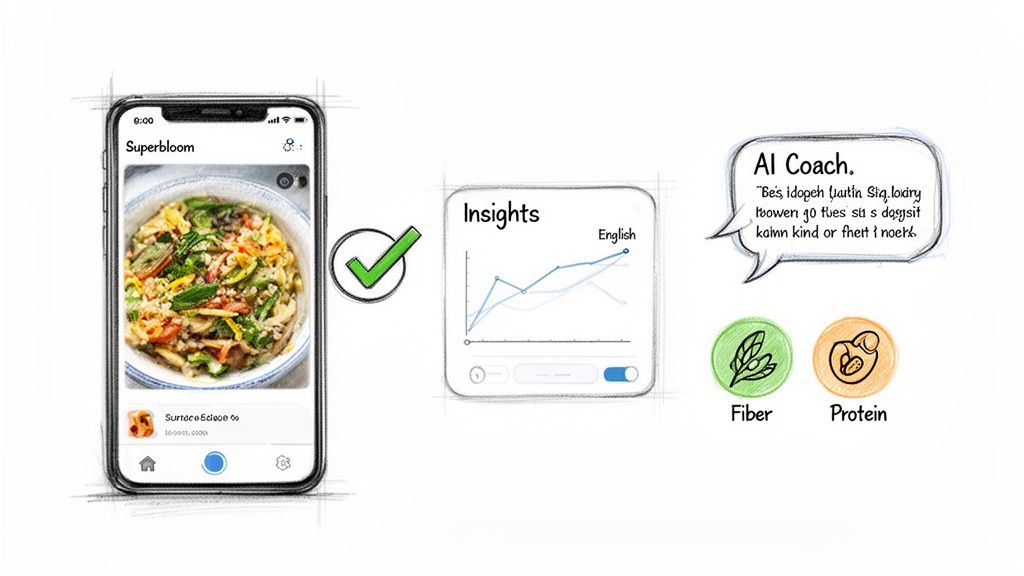
One of the biggest hurdles in intuitive eating is seeing the patterns between what you eat, how you feel, and why. It’s hard to do on your own. Superbloom’s Insights dashboard is built for this exact purpose. By simply snapping a photo of your meals and answering a few quick daily check-in questions, the app helps you uncover your own personal patterns.
You might start to notice that you crave sweets after a tough day at work, or that a certain breakfast keeps you feeling focused for hours. These aren't just data points; they're powerful clues that help you practice principles like "Cope with Your Emotions with Kindness." The app’s AI might gently ask, "I notice you often log cravings after long meetings. What's that like for you?" This kind of question guides you toward finding coping strategies that don't always involve food.
Practice Gentle Nutrition Without Slipping into Old Rules
The idea of "Gentle Nutrition" can feel like a tightrope walk. How do you honor your health without accidentally falling back into a diet mindset? This is where Superbloom’s AI coach can be a game-changer. After you log a meal, it might offer gentle, rule-free suggestions.
For example, instead of a harsh command, it might say:
- "This looks delicious! Adding a source of fiber, like some avocado, could help you feel full and satisfied for longer."
- "Great choice. A bit of protein, maybe some chickpeas, would give you a fantastic energy boost for the afternoon."
This approach is all about supportive guidance, not commands. It helps you make nourishing choices that feel good to your body without creating a new list of "good" and "bad" foods, which is the heart and soul of intuitive eating.
Superbloom’s progress visualizations also help reinforce that this is a long-term practice, not a race. By showing your consistency with check-ins and reflection over time, it helps you celebrate the real work: building back that trust with your body, one meal at a time.
A Few Common Questions About Intuitive Eating
It's completely normal to have a million questions when you first start exploring intuitive eating. After all, for many of us, this means unlearning a lifetime of rules handed down by diet culture. Let's walk through some of the most common things people ask as they begin.
Can I Lose Weight with Intuitive Eating?
This is easily the most-asked question, and the honest answer is: maybe, but maybe not. Some people do lose weight, others gain a little, and many stay right where they are as their body finds its natural, comfortable set point.
The thing is, weight loss is not the goal of intuitive eating. The entire point is to heal your relationship with food and your body. Ditching the scale is one of the most liberating things you can do. It helps you tune out the external noise and finally start listening to your body's own wisdom, which is what this is all about.
How Long Does It Take to Become an Intuitive Eater?
Think of intuitive eating less like a 30-day program and more like learning a new language—your body’s language. It’s a practice you’ll continue to refine for the rest of your life, not a course with a finish line.
How long it takes to feel comfortable and confident really depends on your own unique history with food and dieting.
Some principles might click into place quickly, while others will require more patience and self-compassion as you unlearn old, ingrained habits. The journey is about progress, not perfection.
What If I Have a Health Condition Requiring a Specific Diet?
You can absolutely practice intuitive eating even if you're managing a medical condition like Celiac disease, food allergies, or diabetes. This is where the principle of "Gentle Nutrition" really shines. It’s not about restriction; it's about making food choices that honor both your health needs and your body's signals of hunger, fullness, and satisfaction.
The goal is to find that sweet spot where you're respecting your medical needs without slipping back into a rigid, diet-focused mindset. If you can, working with a registered dietitian who is also trained in intuitive eating can be an incredible source of support here.
Ready to turn these principles into practice with a supportive partner? Superbloom provides the gentle structure and personalized insights to help you build trust with your body, one meal at a time. Learn more and start your journey with Superbloom today.